At 2:54 PM on Friday I became the official owner of the Miss Vicious. Yesterday, in 20 knots and 5 to 8 foot seas, I steamed the boat from Round Pond to Lermond Cove in Rockland, where it will stay until I can fix those things that are broken.
Boat is fat bellied, yet fast and nimble. Beast-like. A one of a kind, in boating parlance, a one-off. I have never seen another boat like it, and I have seen a lot of boats. (I wrote a boat building column for 15 years.) Unfortunately, its current moniker, Miss Vicious, won't work for me.
So how does one go about choosing a boat name? For one thing, mariners consider it bad luck to change the name of a boat, which is why if you're going to do it, you better do it right.
Henceforth, Miss Vicious will be known as MOONFISH.
The Moonfish is a round fish, deep as it is long. Not a schooling fish. Prefers its solitude. Old time fishermen used to consider a good luck fish. Instead of selling them, they would give them away as a gesture of good will. Mostly a Pacific and west Atlantic species, it is a rare breed for these parts.
An added bonus is that the fish is a member of the jack family. My grandfather was named Jack.
-seabgb
Sunday, September 24, 2006


Wednesday, September 06, 2006
Steve Irwin R.I.P.
I offer the following to all the critics of the Croc Hunter:
Marty Steuffer. Marlin Perkins. Jacques Cousteau. Jeff Corwin. Jack Hanna. The list goes on and on. All of these guys, even the most light footed of them, manipulate their encounter with the wild. They have no choice. Baiting, and even lighting, is a form of manipulation. As the physicist Heisenberg postulated: The act of observation in and of itself changes that which is being observed.
I don't consider chasing a snake or croc and trying to grab it by the tail to be cruel, provided there's a reason for it. For example, whenever I see an animal (cat, dog, deer, moose, bear, etc.) lolly gaging on the side of the road, I always stop and chase it back into the woods. I may even throw sticks and rocks at it to get it farther away from the road. Sounds cruel but I'm doing it a favor. I'd much rather see it running away from me in fear than lying in a pool of blood on the pavement.
When the government was trying to establish rules for whale watching in US waters, they sought out the advice of scientists and environmental groups. Originally they were thinking of a 500 meter limit. But the whale watch boats and environmental groups and even the scientists protested, saying they needed to get closer. Their argument was that the need for public awareness as brought about by professional whale watch operators superceded the potential risk to the whales, which was really minimal compared to the risks posed by other commercial traffic.
So, right or wrong, there's a precedent. Interference and observation versus leaving them the hell alone. Most conservationists will agree, it's too late for the latter.
Meanwhile, in terms of animal reactions, I think the instantaneous animal response (what happened in Irwin's case) is not what happens when animals are threatened. It's what happens when the animal is surprised. It sounds like semantics but I think there is a difference. Threatened animals respond by posturing or testing the threat. A snake coils and flicks its tongue. A bear charges and rears up. A dog snarls. Animals run from threats they know they can't handle. They attack those they know they can handle. Until they sense which is which, they're pretty tentative. Of course, the more you screw with them, the more unpredictable they get. If you step on a rattlesnake, you're going to get bit. And, when it comes to wild animals, nothing is certain.
Once while filming blue sharks here in the Gulf of Maine I started handing feeding the sharks whole herring from the side of the boat. There were approximately sixty sharks around the boat at any given time, swimming around in a big circle. I would hold a herring over the side of the boat, and a shark would swim close, tilt his head, roll his eye lids up, open his mouth, and I'd drop the herring in. I did this for about a half hour and didn't stop until the two cameramen came back in the boat for lunch. We were sitting in the boat's cockpit enjoying lunch, with me sitting on the washboard, same place I was when I was feeding the sharks, when this one shark lifted himself three feet out of the water and snapped at the sandwich in my hand. I have personally caught a couple of hundred blue sharks and I have never seen a blue do that. After that experience we all ate our lunch more in the center of the boat.
I didn't know Irwin or know anyone who worked with him, but it seems to me that what you saw on TV and film is what there was to see. Nothing hidden. Unlike so many others in this business -- even Jacque Cousteau, who was notorious for stacking the deck. Oh yeah, and we should point out that unlike Irwin's place in Australia, most croc and alligator farms around the world make their money harvesting skins, not tourism and public education. (Actually, I'm not positive about the last statement, but I'll bet dollars to donuts it's true. Anyone who knows for sure can state one way or the other in an email to me.)
Finally, it seems there's an abundance of real sadness and hurt among those who worked closest to him. That says a lot.
Steve did indeed put himself in danger. He took risks. He chased and caught a lot of wild snakes by the tail. In fact, he had life by the tail too.
Some will say this was nature's way of getting back at him. To them I say bull. This was Steve Irwin's last lesson to people about the wilderness. And I'm sure he would be the first to say: When it comes to the natural world, anything can happen.
Crikey!
-seabgb
Marty Steuffer. Marlin Perkins. Jacques Cousteau. Jeff Corwin. Jack Hanna. The list goes on and on. All of these guys, even the most light footed of them, manipulate their encounter with the wild. They have no choice. Baiting, and even lighting, is a form of manipulation. As the physicist Heisenberg postulated: The act of observation in and of itself changes that which is being observed.
I don't consider chasing a snake or croc and trying to grab it by the tail to be cruel, provided there's a reason for it. For example, whenever I see an animal (cat, dog, deer, moose, bear, etc.) lolly gaging on the side of the road, I always stop and chase it back into the woods. I may even throw sticks and rocks at it to get it farther away from the road. Sounds cruel but I'm doing it a favor. I'd much rather see it running away from me in fear than lying in a pool of blood on the pavement.
When the government was trying to establish rules for whale watching in US waters, they sought out the advice of scientists and environmental groups. Originally they were thinking of a 500 meter limit. But the whale watch boats and environmental groups and even the scientists protested, saying they needed to get closer. Their argument was that the need for public awareness as brought about by professional whale watch operators superceded the potential risk to the whales, which was really minimal compared to the risks posed by other commercial traffic.
So, right or wrong, there's a precedent. Interference and observation versus leaving them the hell alone. Most conservationists will agree, it's too late for the latter.
Meanwhile, in terms of animal reactions, I think the instantaneous animal response (what happened in Irwin's case) is not what happens when animals are threatened. It's what happens when the animal is surprised. It sounds like semantics but I think there is a difference. Threatened animals respond by posturing or testing the threat. A snake coils and flicks its tongue. A bear charges and rears up. A dog snarls. Animals run from threats they know they can't handle. They attack those they know they can handle. Until they sense which is which, they're pretty tentative. Of course, the more you screw with them, the more unpredictable they get. If you step on a rattlesnake, you're going to get bit. And, when it comes to wild animals, nothing is certain.
Once while filming blue sharks here in the Gulf of Maine I started handing feeding the sharks whole herring from the side of the boat. There were approximately sixty sharks around the boat at any given time, swimming around in a big circle. I would hold a herring over the side of the boat, and a shark would swim close, tilt his head, roll his eye lids up, open his mouth, and I'd drop the herring in. I did this for about a half hour and didn't stop until the two cameramen came back in the boat for lunch. We were sitting in the boat's cockpit enjoying lunch, with me sitting on the washboard, same place I was when I was feeding the sharks, when this one shark lifted himself three feet out of the water and snapped at the sandwich in my hand. I have personally caught a couple of hundred blue sharks and I have never seen a blue do that. After that experience we all ate our lunch more in the center of the boat.
I didn't know Irwin or know anyone who worked with him, but it seems to me that what you saw on TV and film is what there was to see. Nothing hidden. Unlike so many others in this business -- even Jacque Cousteau, who was notorious for stacking the deck. Oh yeah, and we should point out that unlike Irwin's place in Australia, most croc and alligator farms around the world make their money harvesting skins, not tourism and public education. (Actually, I'm not positive about the last statement, but I'll bet dollars to donuts it's true. Anyone who knows for sure can state one way or the other in an email to me.)
Finally, it seems there's an abundance of real sadness and hurt among those who worked closest to him. That says a lot.
Steve did indeed put himself in danger. He took risks. He chased and caught a lot of wild snakes by the tail. In fact, he had life by the tail too.
Some will say this was nature's way of getting back at him. To them I say bull. This was Steve Irwin's last lesson to people about the wilderness. And I'm sure he would be the first to say: When it comes to the natural world, anything can happen.
Crikey!
-seabgb
Thursday, August 31, 2006
Exemptions for Canadian Built Fish Tenders in Maine
A minor amendment to the Jones Act appears to give Maine fishermen some regulatory leeway. The new revision, signed into law on July 11, 2006, provides an exemption for Maine fishermen who want to use a Canadian-built vessel to transport fish and shellfish between locations within the State of Maine.
Prior to this change, fishermen could use a Canadian-built vessel of less than 5 net tons to engage in fishing. However, they could not transport merchandise, or any product, including bait and lobster, port to port.
This revision applies to Maine and Canada only. The rest of the U.S., and vessels built in other countries, are not parts of the deal.
I say deal because you have to wonder how this all came about. Not too long ago a local lobster and bait hauling company (Drisko Lobster) ran afoul of The U.S. Bureau of Customs and Border Protection. CBP cited Drisko for violating the Jones Act for using a couple of Novi boats to haul bait and lobster back and forth from the islands to the mainland. Senator Olympia Snow (R, ME) got involved on behalf of the operator, who gave up his business as a result of the final adjudication, which came in against him on September 20th of 2004. Regardless of the immediate outcome of the case, it now looks like the law Snow wanted changed got changed -- but only as it applies to Maine fish haulers like Drisko. The change does not exempt new builds, replacement builds, or vessels running salvage, other cargo, or passenger operations.
The revision, as it stands, addresses Maine vessels under 5 net tons that have engaged in the transportation of fish or shellfish before January 1, 2005. The owner of the vessel must be a U.S. citizen and also must be operating the business pursuant to a valid wholesale seafood license that was issued by the State of Maine prior to the January 1, 2005 cut off. Finally, the owner must submit an affidavit to the Coast Guard certifying adherence to the above conditions no later than 180 days from July 11, 2006.
No matter what you think of pork barrel politicking, you have to tip your hat to Senator Snow from Maine. Somehow she managed to bulldoze a tailor-made change into the most hallowed Jones Act, a piece of legislation that was carved into virtual stone over 86 years ago.
-seabgb
Prior to this change, fishermen could use a Canadian-built vessel of less than 5 net tons to engage in fishing. However, they could not transport merchandise, or any product, including bait and lobster, port to port.
This revision applies to Maine and Canada only. The rest of the U.S., and vessels built in other countries, are not parts of the deal.
I say deal because you have to wonder how this all came about. Not too long ago a local lobster and bait hauling company (Drisko Lobster) ran afoul of The U.S. Bureau of Customs and Border Protection. CBP cited Drisko for violating the Jones Act for using a couple of Novi boats to haul bait and lobster back and forth from the islands to the mainland. Senator Olympia Snow (R, ME) got involved on behalf of the operator, who gave up his business as a result of the final adjudication, which came in against him on September 20th of 2004. Regardless of the immediate outcome of the case, it now looks like the law Snow wanted changed got changed -- but only as it applies to Maine fish haulers like Drisko. The change does not exempt new builds, replacement builds, or vessels running salvage, other cargo, or passenger operations.
The revision, as it stands, addresses Maine vessels under 5 net tons that have engaged in the transportation of fish or shellfish before January 1, 2005. The owner of the vessel must be a U.S. citizen and also must be operating the business pursuant to a valid wholesale seafood license that was issued by the State of Maine prior to the January 1, 2005 cut off. Finally, the owner must submit an affidavit to the Coast Guard certifying adherence to the above conditions no later than 180 days from July 11, 2006.
No matter what you think of pork barrel politicking, you have to tip your hat to Senator Snow from Maine. Somehow she managed to bulldoze a tailor-made change into the most hallowed Jones Act, a piece of legislation that was carved into virtual stone over 86 years ago.
-seabgb
Friday, June 30, 2006
Still More on Ethanol Blended Gas
Remember that article in the Wall Street Journal I mentioned earlier, the one that quotes Chuck Fort from BOAT/US? He said, ". . . ethanol is a powerful solvent." After thinking about this for awhile, and after reading an NMMA (National Marine Manufacturers Association) report, I came to the realization that his statement is a little misleading. In fact, ethanol isn't any more of a solvent than grape juice, or, for that matter, gasoline.
The problem isn’t that ethanol is a solvent, it's that it is incompatible with butyl rubber (e.g. O-rings and hoses) and a certain chemical known as di-iso octyl phtalate, a plastisizer used in fiberglass resin. It also scrubs the protective oxide layer off of aluminum and is electrically conductive. In phase with gasoline (meaning all together as one system), and in blends of 10% or less, most experts will say fegetaboutit. But as I said before, ethanol has this ugly habit whereby it sticks to water more than gasoline. In other words, ethanol will hook up with the condensation in your fuel tank over the gasoline there every time. When it does this, it sinks and concentrates at the bottom of the tank.
So what? So you might have ethanol and water at the bottom of the tank? Big deal. Well, in a fiberglass tank, the ethanol invades the pores of the tank, releasing some of the phtalates. These enter the combustion process and end up forming heavy black deposits on intake valves. That's the theory, anyway, based on analysis of Connecticut valve crud, which shows up as di-iso octyl phtalate.
Aluminum is another story. An oxide layer protects aluminum. No oxide layer. No corrosion protection. Ethanol and water are electrically conductive, so you have a galvanic issue inside the tank to worry about.
Hope this helps.
-seabgb
The problem isn’t that ethanol is a solvent, it's that it is incompatible with butyl rubber (e.g. O-rings and hoses) and a certain chemical known as di-iso octyl phtalate, a plastisizer used in fiberglass resin. It also scrubs the protective oxide layer off of aluminum and is electrically conductive. In phase with gasoline (meaning all together as one system), and in blends of 10% or less, most experts will say fegetaboutit. But as I said before, ethanol has this ugly habit whereby it sticks to water more than gasoline. In other words, ethanol will hook up with the condensation in your fuel tank over the gasoline there every time. When it does this, it sinks and concentrates at the bottom of the tank.
So what? So you might have ethanol and water at the bottom of the tank? Big deal. Well, in a fiberglass tank, the ethanol invades the pores of the tank, releasing some of the phtalates. These enter the combustion process and end up forming heavy black deposits on intake valves. That's the theory, anyway, based on analysis of Connecticut valve crud, which shows up as di-iso octyl phtalate.
Aluminum is another story. An oxide layer protects aluminum. No oxide layer. No corrosion protection. Ethanol and water are electrically conductive, so you have a galvanic issue inside the tank to worry about.
Hope this helps.
-seabgb
Monday, June 19, 2006
Interesting Boats: Have Boat, Will Travel. . . .
Every so often a boat comes up for sale I feel I need to own. Fortunately, it's either priced out of my range, or common sense gets the better of me. The industry trade paper Boats and Harbors is chock full of broken dreams for sale.
For the record, here are two pictures of two truly unique boats. Not sure where they are today, or even if they are afloat:


-seabgb
For the record, here are two pictures of two truly unique boats. Not sure where they are today, or even if they are afloat:
Maagen

Inspektionskutteren MAAGEN ses her med den oprindelige 40 mm kanon
placeret på fordækket.
(Foto fra Orlogsmuseets arkiv)
Seven Seas

-seabgb
More on Ethanol Blended Gas
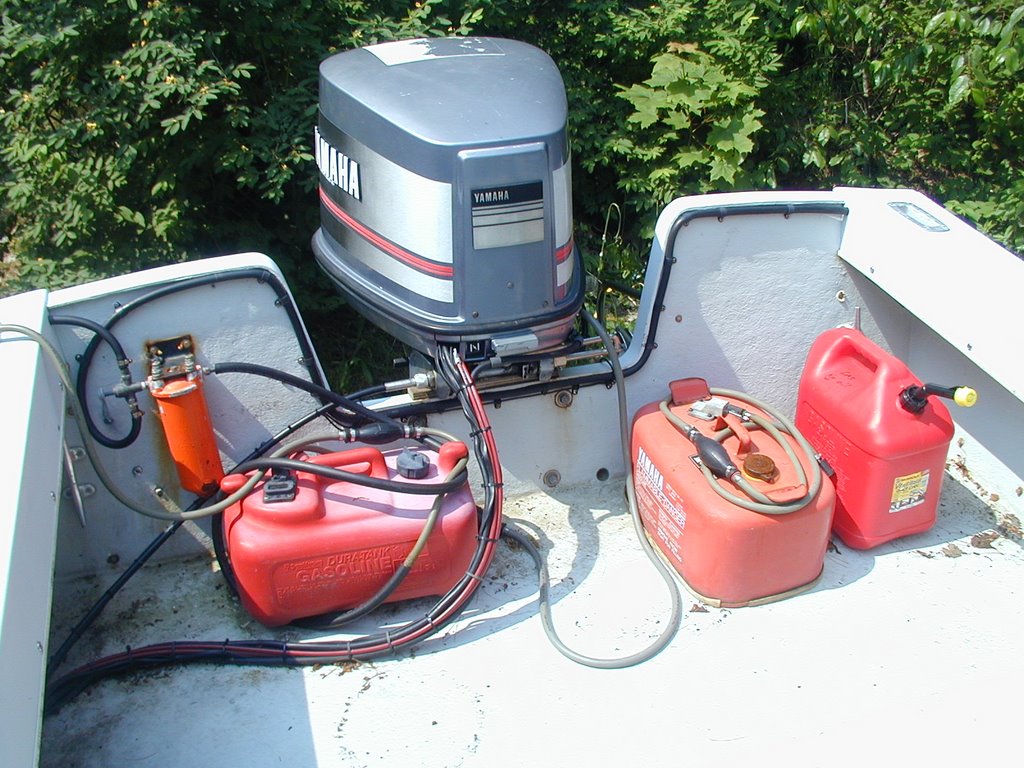
Here's a follow-up on the initial post, which you can find below this one.
Based on reports from boaters in Connecticut and New York, where ethanol-blended gasoline has been in use for over a year, the situation can indeed be problematic. For people with newer boats and engines, the problem is mostly confined to contamination and phase issues. In other words, when water is introduced into the blend, the ethanol gets out of phase with the gas and into phase with the water. (In phase means the two chemical constituents are combined into one system; out of phase means the two parts have separated into individual components.) Once the ethanol and gas have gone out of phase, the water and ethanol combine and settle to the bottom of the tank, leaving a reduced octane gasoline floating on top. In addition, because the ethanol is a solvent, it scours debris from the interior walls of the fuel tank, which causes contamination.
Some people (namely, Chuck Fort from Boat/US), are still suggesting people with older boats consider replacing their fiberglass and maybe even aluminum fuel tanks. I'm still not sure why this is an issue for older boats and not newer boats with the same type tank. I need more info -- like what material is it in the older fiberglass fuel tank that makes it more susceptible to ethanol corrosion. Are they talking about polyester versus vinylester resin? Epoxy resin? Is it the type of fiber we're talking about? The layup? What? Why don't they just say what the problem is? Clearly, it's not how old the tank is but what it's made out of that is at issue. They should just tell us what type of fuel tank construction materials are at risk and not talk to the boating public like they're a bunch of ignoramuses! (Another thing: It's just like the media and Boat/US to assume every person out there is riding around in a production boat, Bayliner, Starcraft, etc. Don't they realize how many boutique and custom boat builders there are?)
Meanwhile, as I mentioned before, these problems can be solved by keeping water out of your fuel tank, watching your filters and changing them more frequently, and making sure you use whatever gas you buy so it doesn't end up being stored in the tank for weeks at a time.
Unless of course, the place where you buy gas is selling contaminated and out of phase product. All your precautions won't amount to much if the gas you pump into your tank is contaminated with debris and already out of phase. You'll think you're getting 89 octane but what you're really getting is something with a lot less punch and a lot more dirt.
My recommendation is to find a place where the test of time has proven you can trust the gas. Stick with one place and don't shop around. You start to have engine problems, clogged filters, etc., flush the filter and fuel lines, replace elements, and find someplace else to get gas.
Another thing, the amount of water in the tank that they say is needed to cause problems is 1/2 of 1%. In a ten gallon tank (1280 fluid ounces) we're talking about 6.4 fluid ounces of water. A little less than a cup.
-seabgb
Friday, June 16, 2006
Is Ethanol-Blended Gasoline Bad for Boats?

An article in a recent Wall Street Journal points to serious problems for boaters as a result of ethanol being used to replace MTBE as an additive in gasoline.
According to the article, condensed water in the boat's fuel tank causes the ethanol to separate from the gasoline. This creates a situation where the bottom of the tank has an ethanol and water mix and the upper part of the tank has a seriously reduced octane fuel. Engines don't like to run on reduced octane fuel, and they really don't like being force fed ethanol and water. Two stroke outboards, twenty years old and older, are particularly sensitive to this and can be permanently damaged. The article further contends that all older hoses and components made with natural rubber (including O-rings) will be damaged and that ethanol is very caustic to fiberglass and possibly also to aluminum fuel tanks.
According to the article, which quotes a spokesman from BOAT/US, Chuck Fort, a purported expert on boat maintenance, ethanol is a powerful solvent. Separated from the gasoline, it will dissolve the residue on the inside of the tank and further contaminate the fuel with particles and debris. It will also, according to Fort, accelerate deterioration in fiberglass and possible aluminum fuel tanks. Fort went on to say that owners of boats with fiberglass tanks will have to replace the tanks.
While following up on this story and reviewing various chemical resistivity charts for ethanol (a.k.a. grain alcohol, hydroxyethane, ethyl alcohol) I could find no evidence to support the assertions that ethanol is caustic to these materials and/or likely to cause rapid deterioration in rubber, fiberglass compounds or aluminum. In fact, according to the chemical resistivity chart published by the Cole-Parmer Instrument Company, ethanol is less caustic than grape juice. It's also lighter than water and evaporates rapidly in air.
Meanwhile, I also found this on the web:
Table 1. Comparison of MTBE and ethanol properties (Rice, 1999).
Ethanol compatibility with metals and nonmetals
Ethanol and ethanol blends of gasoline conduct electricity
whereas unblended gasoline is an electrical insulator. Thus,
pure ethanol is more corrosive than gasoline, and materials-
compatibility is an issue. Pure ethanol and gasoline with high
percentages of ethanol should not be used with aluminum,
zinc, tin, lead-based solder, or brass fittings. Nonmetallic
materials that will degrade in the presence of ethanol include:
• natural rubber
• polyurethane
• cork-gasket materials
• leather, polyester-bonded fiberglass laminate
• polyvinyl chloride, polyamides
• methyl-methacrylate plastics
Reference
Rice, D.W.; G. Cannon, editor and R. Depue, contributor,
“Background Information on the Use of Ethanol as a Fuel
Oxygenate,” Volume 2, in Health and Environmental
Assessment of the Use of Ethanol as a Fuel Oxygenate,
December 1999, University of California, Lawrence Livermore
National Laboratory, Environmental Restoration Division,
UCRL-AR-135949, Livermore, California; http://www-
erd.llnl.gov/ethanol/.
So, what does it all mean? Is ethanol bad or not? Seems in high concentrations it is. But . . . ethanol blended gasoline doesn't have more than approximately 10% ethanol. And yet, if it separates from the gasoline due to an interaction with water, it then becomes a pocket of pure ethanol somewhere in the tank.
Boat owners and boat buyers need to be aware of this issue and keep abreast of technical updates. While the Wall Street Journal isn't exactly the horse's mouth when it comes to technical accuracy on boating issues, the story should trigger further scrutiny. What we need is a Coast Guard bulletin we can trust.
Clearly, more information and study is warranted before individual boat owners embark on the costly enterprise of replacing their fuel tanks.
One thing for certain, if indeed water causes ethanol to separate from gasoline, it makes sense for boat owners to refresh their fuel often by making sure they burn what they fuel up with (not keep it stored for extended periods of time) and change their filters frequently. But this is something you should be doing regardless.
-seabgb
Wednesday, June 14, 2006
Wednesday, June 07, 2006
Monitoring the Marine Forecast

You might notice how the forecast for a particular weather event will change or fluctuate in severity over the course of a forecast period. This isn't so unusual when you consider how local weather events are predicted. It's true, the forecasters have a great deal of scientific muscle at their disposal in the form of complex computer models, but the vagaries and uncertainties will never be completely eliminated. After all, it doesn't take much for a low pressure area moving up the coast to swing a few degrees one way or the other, turning an intended gale into a pussycat or a small craft advisory into a major blow.
One way to protect or prepare yourself is to never assume a given forecast is static. All too often, people get caught making assumptions. But don't blame the weatherman. Don't expect small craft advisory conditions with a major depression working up the coast just because the forecast calls for winds of 15 to 25 knots. As the saying goes, "Hope for the best, Plan for the Worst."
For example, nothing helps the mariner more than timely information. Keep abreast of changes in the forecast. When you see or hear NOAA report a gale at 23:00, and then see or hear the same report downgraded to a small craft advisory by 07:00, don't be so sure. If the low hasn't yet passed your latitude, anything is possible. In fact, sometimes a forecast will go back and forth for hours, especially when the weather system in question is a tropical or sub-tropical low.
Subtropical low courtesy of Wikipedia.com
So, beware the forecast. Don't blame the weatherman. Stay tuned to NOAA weather radio. And never assume your forecaster has a lock on accuracy.
-seabgb
Tuesday, June 06, 2006
Buyer Beware
This is hard to believe, and yet I swear it happened just as I describe below:
I followed up on an ad for two Dyer 40' passenger boats. These were listed in the classified section of an industry paper called, Boats and Harbors, the bible of commercial boat shopping published in Knoxville, TN.
Anyway, the guy I spoke to on the phone told me the boats were originally built to take passengers on trips in the Chesapeake. The vessels were later purchased by a tour company in Lake George. I asked about the layout and the guy suggested I come to New York to see for myself. I asked about the cabin, and he said the hulls were in excellent condition, that if I came up he would meet me and go through both vessels with me. Sounded good, until a little birdy started singing in my head.
Dyer 40s. On Lake George in New York. Two of them. Does the name Ethan Allen ring a bell? Let me refresh your memory:
-seabgb
I followed up on an ad for two Dyer 40' passenger boats. These were listed in the classified section of an industry paper called, Boats and Harbors, the bible of commercial boat shopping published in Knoxville, TN.
Anyway, the guy I spoke to on the phone told me the boats were originally built to take passengers on trips in the Chesapeake. The vessels were later purchased by a tour company in Lake George. I asked about the layout and the guy suggested I come to New York to see for myself. I asked about the cabin, and he said the hulls were in excellent condition, that if I came up he would meet me and go through both vessels with me. Sounded good, until a little birdy started singing in my head.
Dyer 40s. On Lake George in New York. Two of them. Does the name Ethan Allen ring a bell? Let me refresh your memory:
Not once in the conversation did the guy mention to me the history of the boat. You would think it would be something important to mention given that I had to travel a total of about 700 miles to see it. Can't wait for this guy to call me back.Ethan Allen boating accident
From Wikipedia, the free encyclopedia
(Redirected from Ethan Allen Boating Accident)On October 2, 2005, the tourboat Ethan Allen capsized on Lake George, in Upstate New York, at 2:55 PM.
 Ethan Allen is raised by investigators after capsizing and sinking 70 ft underwater.
The Ethan Allen was a small glass-enclosed boat operated by Shoreline Cruises. The boat was carrying 47 passengers, mostly seniors, of which 20 died. It is believed that the boat capsized due to waves caused by a larger cruise ship (The Mohican). However, tourists at a nearby camp reported that the Mohican passed by the area where the Ethan Allen sunk 20 minutes later. The boat has been raised by investigators.
It was confirmed that weather was not a factor in this accident, as the skies were blue and the wind was calm. The 20 people that died are believed to have died from drowning, not hypothermia, as the water in the lake was 68 degrees Fahrenheit. The injured people were sent to Glens Falls Hospital via Hague, Warrensburg, North Warren, Moreau and Lake George Ambulances.The boat was carrying a tourist group, the Trenton Travelers, based out of Trenton, Michigan. It has been confirmed that all the passengers were from Michigan and Ohio.

-seabgb
Friday, June 02, 2006
The Perfect Storm Revisited

Not that it was a bad movie, or lacked drama and good characterization, but there were enough technical inaccuracies to cause this mariner trouble.
First of all, let's ask some questions:
Why were the outriggers out and the paravanes down when the seas were in the 80' to 150' foot range (as depicted; more if you consider the last wave)? Why did the crew wait so long to batten down the wheelhouse windows? They knew the storm was coming. They knew how bad it would be. Why didn't they make proper preparations to meet it?
Why wasn't the crew in the wheelhouse? I've been in some bad blows, and when it gets really bad, everybody usually hangs out in the wheelhouse with their survival suits within arm's reach. When it's that bad, and the boat has to turn around in monster seas, riding out the turn in the fo'c's'le or galley is the last thing anybody wants to do.
Why would anyone think they could remount a SSB antenna in a 50 knot wind when the smallest whip antenna is about 23'? If the antenna doesn't rip your arm off, how are you going to splice the coax? And why not just lay out an emergency long wire antenna on deck?
Speaking of which: I thought the Andrea Gail had a long wire antenna and not a whip antenna. I believe that in the photo of the Hannah Boden, which Linda Greenlaw states is a sistership of the Andrea Gail, you can see a long wire antenna running aft from the masthead to the goal post.
By the way, Greenlaw states in her book that her boat, the Hannah Boden, was 100'. Sebastion Junger, the author of the book, stated on a pre-movie hype news program that the Andrea Gail was 80'. I tend to believe Greenlaw over Junger regarding LOA. And I tend to believe it had a long wire antenna. You'd think it would given its range of operation. Also, if the boat was 100' , the wave at the end would have been about 200'. My understanding is that the largest non-seismic wave ever recorded was 112', measured scientifically in the North Pacific by researchers aboard the USS Ramapo on February 7th, 1933.
Also....
Where can I get one of those blow torches that stays lit after it gets dunked in seawater?
Don't get me wrong. I liked the movie. I liked the effects. I thought the film makers did some good things. But I don't think the movie paid homage to the crew of the Andrea Gail or commercial fishermen. I think Junger's melodramatic overspeculations of the sinking (not to mention his speculation about what it's like to drown) are an insult to the thousands of fishermen and other seafarers who've lost their limbs and worse in much less spectacular ways. In truth, the vast majority of commercial fishing accidents and sinkings, aren't caused by gigantic Hollywood waves. They're the result of separate incidents and seemingly insignificant details stacking-up and falling like a house of cards.
With all due respect to the people of Gloucester and the friends and family of those who died on the Andrea Gail, and to the film makers and the actors, I humbly submit a different cause and effect scenario with regard to the sinking.
In my opinion, had the crew been given the time depicted in both the book and the movie, the ending might have been quite different. Those men were experienced and capable fisherman who had previously handled anything the sea had thrown at them. What probably happened was they started home with a freighted boat. It got rough, very rough, and the vessel started taking on water, probably from some insidious place in the stern, e.g. the rudder box or shaft seal. They didn't know she was taking on water until it was too late, at which time the vessel rolled and sank before they could launch the raft, get into their survival suits, or trigger the EPIRB. How many times has it happened that way? A freighted boat. A slow leak. Bad weather.
-seabgb
Wednesday, May 31, 2006
Sea Stories on Film
 Here's a list of my favorite movies about the sea, with a brief description and review, in no particular order:
Titanic. This is Cameron's version and no doubt one with a sophomoric, fictionalized inner story about Jack and Rose and unrequited love. Ugh! Nevertheless, Cameron's attention to detail combined with his knowledge of the sea provide superb visuals and a realistic account of the physical aspects of the actual disaster. Very dramatic but also manipulative emotionally.
A Night to Remember. Can't leave this one out if we're mentioning the one above. A faithful retelling of the tragedy as originally described by eyewitness and written accounts. Based on the book of the same name by Walter Lord and including the dramatic stories of real passengers. Not a tear jerker in the modern sense but a movie that leaves an indelible mark on the brain.
The Abyss. Cameron cut his sea teeth on this one. A sci-fi underwater flick with great character interactions, a decent love story, and fantastic underwater scenes. Worth watching, except for the very end, where Cameron presumably ran out of money and had no choice but to feed Mary Elizabeth Mastrantonio one of the dumbest lines ever recorded. Still, a great popcorn flick with lots of exciting scenes.
Perfect Storm. Wolfgang Peterson's movie version of Sebastion Junger's book of the sinking of the Andrea gale, a swordfish longliner out of Gloucester, MA. Movie depicts some real personalities (as we see in the bar scenes) and has a few decent scenes but is over the top in both action and it's speculative reasoning as to the exact cause of the tragedy. (More on this at a later date.) Not so much Peterson's failt as it was Junger's, who overdramatized his book and gave us way too many of his unqualified opinions.
Das Boot. Can't leave out Peterson's terrific U-Boat movie.
Moby Dick. The Gregory Peck version. Nuff said
Master and Commander. Underrated. With Russell Crowe. Opening scene is worth the price of admission.
The Caine Mutiny. Humphrey Bogart leads a great cast in this dramatic and telling tale of disloyalty, dishonor and failed leadership on the high seas. None better.
Mutiny on the Bounty. Two version worth seeing, the original with Laughton and the remake with Mel Gibson.
The Wackiest Ship in the Army. All right. Not the greatest movie ever, but if you're a fan of sea stories, you have to watch it. Jack Lemmon finally gets command of a ship, but it's a rotten old schooner. His mission: To spy on the Japanese in the South Pacific. Not much plot but a great premise and lot's of good boating scenes.
Down Periscope. Kelsey Grammer plays Thomas Dodge, a modern Navy sub captain who gets his first command, a rusting diesel sub. Sound familiar? Instead of spying on the Japanese, Dodge must engage his own Navy in a war game that requires him and his crew to infiltrate a gauntlet of U.S. warships and blow up one of the mothballed derelicts at Norfolk. Low brow humor with more than a few laughs.
The Bedford Incident. Great cold war story with Richard Widmark in a cat and mouse game in the North Atlantic. Sidney Potier plays a liberal journalist-guest aboard ship. Bottom line: The most insignificant details can have most disastrous consequences.
Jaws. Almost deserves its own post. The movie that single handedly changed the film industry and also almost decimated a fishery.
Pirates of the Caribbean. Somebody knew a little about boats when they penned this Disney ride adaptation. They knew how to have fun, too, which is what most viewers will have when they sit down to watch it. Movie pays homage to pirate lore and other genre films that have come before it, including Polanski's Pirates, which is also worth a look. Check out Walter Matthau's performance as Captain Red. You'll be hooked, literally, in the first five minutes.
Mr. Roberts. What better movie of men aboard a Navy ship is there. Superb performances all around. One of the few films that succesfully blend laugh out loud humor and tragedy. Finale says it all. Perfection.
Crimson Tide. Insubordination and mutiny (or is it?) aboard a U.S. nuclear attack sub in the vein of The Cain Mutiny. Very well executed and played by Denzle Washington, Gene Hackman and others.
The Cruel Sea. Film adaptation of Nicholas Monsaratt's excellent novel of war on the high seas. Novel came out in 1953 (year I was born) and is probably the best novelization of service in Her Majesty's Navy during World War II. Movie faithfully sticks to Monseratt's vision and includes superb performances by the all British cast.
The 7th Voyage of Sinbad. Groundbreaking fantasy film with legendary special effects by master minaturist, Ray Harryhausen. Even cooler that it happens to be a sea adventure.
There are, of course, a great many more noteworthy movies with maritime or naval themes. I can think of several terrific war stories, including Sink the Bismark. Maybe later I'll add to the above list.
-seabgb
Subscribe to:
Posts (Atom)