Saturday, April 17, 2010


Friday, April 16, 2010
VHF DSC Automatic Channel Switching Safety Alert!
For more information on what radios and/or manufacturers are impacted by this alert go here.
I have long been a critic of these types of brainless innovations, brainless because they assume we have no brain. Automatic Channel switching is like the automatic car door that locks when you turn the ignition key. I don't need my car telling me when to lock my door and I sure don't need the radio manufacturers telling me what channel I need to listen to and when I need to listen to it.
Meanwhile, the Coast Guard is recommending that mariners turn off the Automatic Channel Switching feature in radios if they are so equipped.
~seabgb
South Korean Warship Struck by Mine? (Updated May 19)
 Part of the South Korean ship that blew up and sank in waters bordering South and North Korea has been salvaged. South Korean Investigators are now pointing to an external explosion. The CNN World article is here.
My problem with the article is that it suggests the potential for nuclear engagement between the two countries instead of providing details of the salvage or the investigation. Apparently, CNN prefers to trade in tension, strife, fear and anxiety than straight news. Ooh, what can we expect South Korea to do? They have six nukes.
Chances are the thing hit an old mine or torpedo. It might have been South Korean. It might have been North Korean. If it's a old mine, who cares whose it is?
I doubt the explosion and sinking were caused by a North Korean torpedo or missile. And I doubt South Korean authorities think otherwise. But CNN has to make it sound like the beginning of a war or how ever would they compete with the all-action F/X Channel and their reruns of The A-Team?
[Today, May 19, the Wall Street Journal reports that S. Korea will officially blame N. Korea for sinking the vessel with a torpedo fired from a submarine.]
It's dangerous sailing around in war-ravaged waters. There are all kinds of unexploded ordnance. It happens. It's unfortunate. Soldiers die on routine patrols. They die watching the gates. They die when they're not supposed to. Let's not turn this thing into the beginning of WWIII or make idiotic comparisons to what happened with the U.S. spy ship Pueblo.
Shame on you CNN.
~seabgb
Tuesday, April 06, 2010

Thursday, April 01, 2010
USS Nicholas Nabs Three Pirates; Sinks PIrate Skiff

OK, this report (CNN Story Here) has me scratching my head a little. Not that there's a lot to go on, but think about it: A U.S. warship returns fire when shot at by three men in a skiff. This happens at night. Nobody gets hurt. The pirates are eventually captured and the skiff sunk. Not far away, the crew of the Nicholas find the skiff's mother ship. They capture it and take custody of a few more pirates.
We have a fairly substantial warship with a great deal of firepower letting loose on a skiff with three guys in it. What happened? Did they miss? Were they firing warning shots? How does a "skiff" (we still don't have details on the type or size of craft but we can assume it's pretty small by comparison) survive such an onslaught? How do the three pirates manage to survive?
While I'm asking questions, who are these three, lightly armed pirates in a skiff attacking a U.S. warship? Are they mentally challenged, drunk, senile...? Had they just watched Peter Sellers in the movie "The Mouse that Roared"?
So now the international maritime lawyers will get into the act, and maybe even the U.N. What will happen to the pirates? Will they be jailed somewhere? Where? Who will want them? More than likely they will be sent bank to the place from which they originated. And more than likely, after a brief internment, they will get another skiff and try to hijack another vessel. Maybe next time they'll try for an aircraft carrier.
-seabgb
Wednesday, March 24, 2010
Kill More Pirates, Please!
Private guards kill Somali pirate for first timeNAIROBI, Kenya — Private security guards shot and killed a Somali pirate during an attack on a merchant ship off the coast of East Africa in what is believed to be the first such killing by armed contractors, the EU Naval Force spokesman said Wednesday.
The death comes amid fears that increasingly aggressive pirates and the growing use of armed private security contractors onboard vessels could fuel increased violence on the high seas. The handling of the case may have legal implications beyond the individuals involved in Tuesday's shooting.
"This will be scrutinized very closely," said Arvinder Sambei, a legal consultant for the U.N.'s anti-piracy program. "There's always been concern about these (private security) companies. Who are they responsible to?"
The guards were onboard the MV Almezaan when a pirate group approached it twice, said EU Naval Force spokesman Cmdr. John Harbour. During the second approach on the Panamanian-flagged cargo ship, which is United Arab Emirates owned, there was an exchange of fire between the guards and the pirates.
An EU Naval Force frigate was dispatched to the scene and launched a helicopter that located the pirates. Seven pirates were found, including one who had died from small caliber gunshot wounds, indicating he had been shot by the contractors, said Harbour.
A statement by the Spanish Ministry of Defense said the warship Navarra had intercepted two skiffs and a larger vessel believed to be a pirate mothership. Spanish forces arrested the six remaining pirates, took custody of the pirate's body and sunk the larger boat, it said.
The two smaller skiffs had many bullet holes in them, the statement said. Spain was trying to reach the Somali government to hand over the body and get the cargo ship's crew to identify the detained suspects as their attackers. Spain was also trying to reach the ship's owner so formal charge of piracy could be laid and the detainees turned over to the Seychelles or Kenya under an agreement the two countries have with the EU.
Sambei said the case could become legally complicated. Investigators would have to establish who had jurisdiction — the flag the vessel was flying, its owners or the nationality of the contractors — and who was responsible for the security contractors in order to set up an independent inquiry, she said.
"The bottom line is somebody has been killed and someone has to give an accounting of that," she said.
Violent confrontations between ships and pirates are on the rise. Crews are becoming increasingly adept at repelling attacks by pirates in the dangerous waters of the Indian Ocean and Gulf of Aden and many ship owners are using private security. But pirates are becoming more aggressive in response, shooting bullets and rocket-propelled grenades at ships to try to intimidate captains into stopping.
Several organizations, including the International Maritime Bureau, have expressed fears that the use of armed security contractors could encourage pirates to be more violent when taking a ship. Sailors have been hurt or killed before but this generally happens by accident or through poor health. There has only been one known execution of a hostage despite dozens of pirate hijackings.
International navies have killed about a dozen pirates over the past year, said Harbour. Hundreds more are believed to have died at sea, either by drowning or through dehydration when their water and fuel runs out, said Alan Cole, who heads the U.N. Office on Drugs and Crime's anti-piracy initiative.
Pirate attacks have not declined despite patrols by dozens of warships off the Somali coast. The amount of ocean to patrol is too vast to protect every ship and pirates have responded to the increased naval presence by moving attacks farther out to sea.
Experts say piracy is just one symptom of the general collapse of law and order in the failed state of Somalia, which has not had a functioning government in 19 years. They say attacks on shipping will continue as long as there is no central government capable of taking on the well-armed and well-paid pirate gangs.
Associated Press Writer Daniel Woolls in Madrid contributed to this report.
Copyright © 2010 The Associated Press. All rights reserved.
Monday, March 22, 2010
Does the Obama Administration Know What it's Doing with the Jones Act?
 Solitaire, Largest Pipe Laying Ship in the World. Courtesy of Wikipedia.
Jones Act Preamble:
It is necessary for the national defense and for the proper growth of its foreign and domestic commerce that the United States shall have a merchant marine of the best equipped and most suitable types of vessels sufficient to carry the greater portion of its commerce and serve as a naval or military auxiliary in time of war or national emergency, ultimately to be owned and operated privately by citizens of the United States; and it is declared to be the policy of the United States to do whatever may be necessary to develop and encourage the maintenance of such a merchant marine, and, in so far as may not be inconsistent with the express provisions of this Act, the Secretary of Transportation shall, in the disposition of vessels and shipping property as hereinafter provided, in the making of rules and regulations, and in the administration of the shipping laws keep always in view this purpose and object as the primary end to be attained.– Sec. 1. Purpose and policy of United States (46 App. U.S.C. 861 (2002)), MARAD
You can find more on the Jones Act here.Curiously, what has happened over the last few months suggests that on this issue at least the Obama Administration is more about platitudes than substance. In an effort to strengthen the Jones Act the Administration tried to institute sweeping changes to the rules that apply to vessels servicing the oil and gas industry on the Outer Continental Shelf (OCS). For thirty years these areas were regulated by the Bureau of Customs and Border Patrol (CBP) as if they were both inside and outside the purview of the Jones Act. Regulations and rulings were interpreted and addressed on a case by case basis.
But the Administration, through the CBP, proposed major changes that would have severely restricted foreign vessels and crews from working on the OCS. Sounds like a great development for U.S.-flagged vessels and crews and U.S. shipyards. The only problem is the oil and gas industry is highly specialized. For example, it may require the use of a vessel capable of burying pipe and a specific depth, a vessel like the Canyon, one of only two of its kind in the world.
The Administration had to back off on its proposed rulings as a result of feedback from the industry and the Department of Homeland Security. A restriction of the use of foreign vessels on the OCS at this time, without the availability of similarly equipped and crewed U.S. vessels, would hamper U.S. energy interests and potentially threaten U.S. security.
-seabgb
Wednesday, March 10, 2010
Administration Wants to Take Away Your Rights to Recreational Fishing!
Why is this happening? Because NOAA/NMFS has done such a terrific job of managing our territorial seas and inland waterways? Yeah, right!
Just for a second, forget that our management of the commercial fisheries has been such an abject failure. Think about who these waters belong to. They belong to us. To all of us. Every man, woman and child on the planet. Denying access and/or regulating access to the point of making it inaccessible is a violation of our basic right to a resource that should not be apportioned or awarded selectively. It's ours.
Every day more and more of the freedoms we took for granted are being taken away. For example, you can't take winnings from the lottery and buy a boat to start commercial fishing. You could have done it in the 1800s and most of the 1900s. You can't do it now. The fisheries are essentially closed. Not enough fish. Used to be, you start with a row boat, catch and sell bait, buy a bigger boat, catch more fish, buy more boats, hire captains, sell more fish, become an industry tycoon. That was the American way. But screw the American way. It's ancient history. And maybe it should be. Maybe it's why we're in this mess. The American way led to too many adventurers and too many tycoons and as a result too many fish and fish habitats went by the wayside. I'm sure most socialistas and communistas would agree. (Hah! As if the socialists and communists aren't leading the way in resource exploitation.)
This knee jerk mentality of the Administration holds no logic. There is no holy world order that will fix the state of the oceans or keep foreign government from deforesting the planet. There is no upside to creating a giant government bureaucracy and no future in trying to police and manage something that can't be policed or managed.
I've said this before. Instead of restricting people, why not restrict areas? At least areas (and species) can be policed and managed. Protect habitat. Protect fish. Protect wildlife. Set aside no-fish zones that can be watched by air and by boat. Create management areas. Exclusion areas. Anything else is just the government creating more paper and more paper pushers. I guess that's what they want. It's what they're good at. Pushing paper. Creating paper. Make everyone pay for a license, a registration.
If John Q. Public knew what the average commercial fishermen had to go through every year in order to ply his (or her) trade he'd be stunned. The average commercial fisherman pushes more paper and complies with more regulation than a doctor or lawyer. Does that make any sense?
-seabgb
Wednesday, February 24, 2010
Killer Whale Kills Trainer at Seaworld
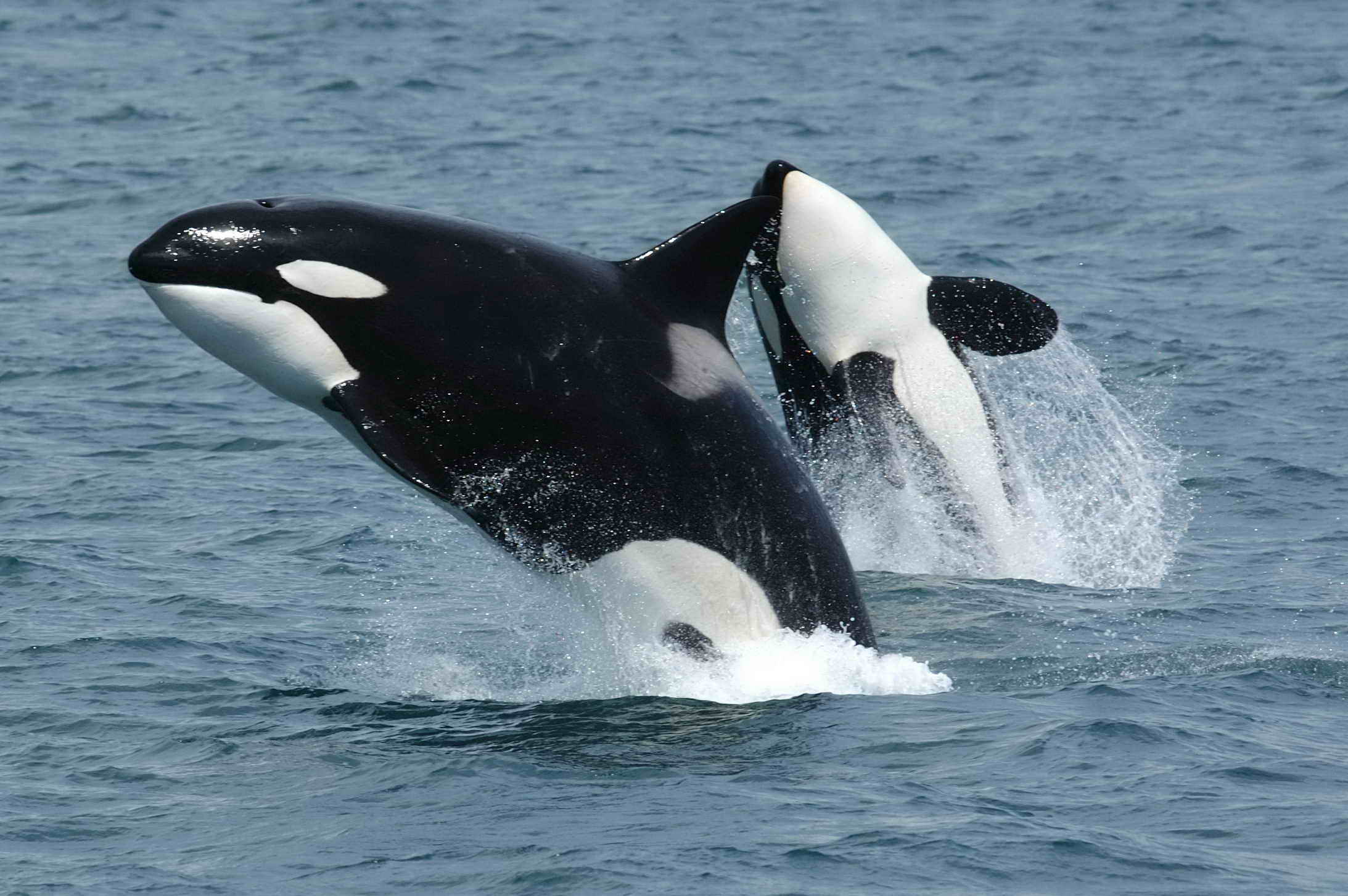 These are killer whales in the wild. Notice how nice and firm and erect their dorsal fins are. Now look at the photo of a killer whale in captivity; sorry, I don't have one handy that's in the public domain. But trust me, a killer whale in captivity has a limp dorsal fin. Why do to you think that is? Probably it happens because they're cooped up in a relatively tiny tank and forced to interact with humans in a way that is completely contrary to their natural tendencies. Maybe it's purely physical, or maybe it's a sign of depression. Maybe it's both. Either way, these are some of the Earth's largest, most violent, most intelligent creatures. Nobody should be surprised when they get pissed off about being held in captivity and forced to perform stupid tricks for their sustenance.
My heart goes out to the dead woman trainer's family. I have to assume she knew and accepted the risks of playing patty cake with a 6 ton killer whale.
-seabgb
Sunday, January 31, 2010
Stimulus Money to Fund Construction of Arctic Research Vessel

OK, so this smacks a little of pork barrel spending and government waste.
Here's the story: SFOS News University Research Vessel.
What I would like to know is the following: Why are we (the taxpayers) building a $200 million ship in Wisconsin if the ship is to be used exclusively in Alaskan waters? There are plenty of qualified builders on the west coast. Why do we have to build it in Wisconsin and then pay to have it delivered through the Great Lakes, the Saint Lawrence, down the East Coast, across the Gulf, through the Panama Canal and all the way up the West Coast?
Also, look at the photo above. Why are we installing unprotected azimuth-type propulsion pods on a vessel designed to break 2.5 feet of ice? I realize these propulsion systems provide excellent maneuverability and efficiency in ice, and I realize they have been installed with success on very large icebreakers, including the new Mackinaw, but has anyone conducted research on the collateral effects of breaking ice on pod-mounted propellers? What are the maintenance and repair issues with the pods and the propellers on these types of systems?
The following is an 2007 excerpt from a icebreaker design assessment provided by the Polar Research Board and the Marine Board.
I believe we have been choosing these systems because of the multi-mission tasks of the new icebreakers. In addition to their icebreaking, these ships are required to perform station-keeping jobs such as Nav-Aid Service and research. The 360 degree azimuthing pods are excellent at keeping a ship on station by providing highly quantied thrust in a specified direction. But are the propulsion systems truly robust enough for the job of icebreaking?Propulsion Plant Design
Icebreaker propulsion plants have changed dramatically since the first sail-powered icebreakers. Steam and later diesel engines drove power through reduction gears to fixed pitch propellers. Those systems were prone to mechanical damage as the propeller struck ice chunks broken at the bow. Later, controllable pitch propellers were tried.
The current systems use electric drives that decouple the propellers from the prime mover to reduce ice impact damage. (Consider that some of the ice chunks moving under and along the icebreaker’s hull are the size of a school bus). The electric drive systems use propellers connected directly to an electric motor. The electricity to drive the motors is produced by onboard generators. Those generators can be driven by diesel engines, gas turbines, or steam turbines (with either nuclear or conventional fossil fuel boilers). The electric drive systems also give greater flexibility for engine room design and eliminate the need for shafts and reduction gears.
To further protect the exposed propellers, nozzles or ducts were installed around the propellers. These had the added benefit of increasing thrust by improved water flow. The current state of the art in icebreaker electric drive with power units is considered to be azimuth pod drives (as installed on the latest U.S. Coast Guard icebreaker MACKINAW); however, some consider them to still be in the developmental stage and unreliable. An azimuth pod drive is an enclosed unit that hangs below the hull and contains the electric drive motor attached directly to a propeller. The azimuth pod is capable of being rotated 360 degrees, enabling full thrust to be applied in any direction very quickly. Azimuth drives have been used extensively on cruise ships and other commercial vessels including ice-strengthened ships.
Manufacturers and multi-mission advocates point to the performance benifits these systems give to icebreakers, e.g. more icebreakeing capability with less power, being able to widen channels in the ice by moving the ship sideways, and being able to break ice astern. However, are these performance characterstics that were intended from the start, or are they qualities the crews discovered after the fact? More important, how often are these vessels out of service due to propeller and/or pod damage?
~seabgb
Thursday, January 21, 2010
Should A Government Agency Have My Email Address?
205 Church Hill Road, Augusta ME 04330
Telephone: 207-622-5503
FAX: 207-622-5596
Email Notice from Fish and Wildlife below:
informational emails to our online customers. We only send these e-mails out to
customers who have indicated that they would like to receive them.
Recently, we had a Freedom of Access Act request from an individual who represents
an organization for our customer e-mail address list. The Freedom of Access Act is a
statute that requires a state agency to provide public records to anyone upon
request. Our initial response to the individual was that our customer e-mail
address list was not a public record and was therefore not covered by the Freedom of
Access Act. The individual appealed our decision with the Maine Attorney General's
office that ruled in favor of the individual and directed IF&W to provide our
customer e-mail address list to the individual. Therefore, we have recently provided
our customer e-mail address list to the requesting individual per the direction of
the Maine Attorney General's Office.
The list contains only e-mail addresses, no other personal data is on the list. We
wanted you to know that we did everything in our power to protect your privacy and
apologize in advance for any issues this may cause you.
Monday, January 18, 2010
Somali Pirates Net Their Biggest Ransom

Story here.
Somali pirates released their latest prize yesterday after receiving a reported $7 million in ransom. According to reports the money, which was apparently dropped to the deck by a helicopter, sparked a deadly feud among the pirates. No further details have been made available. If I had to guess, I'd say some of the pirates wanted to keep all the money while others felt obliged to send a chunk to their Al Qaeda supporters.
Third world sympathizers and apolologists, insurance companies, and liberal intellectuals continue to deny the maritime industry a cohesive anti-piracy deterent. Until such time as mariners are allowed to defend themselves by any and all means available the pirates and their Islamic terrorist associates will have no incentive to stop their crime spree on the high seas.
~seabgb