Saturday, December 17, 2005

Right Turns Only

I think the temperature peaked at 13 degrees on Wednesday. In preparation for what I knew would be a very cold day, I did some shopping at the local chandlery. I bought several pairs of blue clam gloves and these orange gloves that have silicone non stick on the outside. In combination they seem to work pretty well. I also bought a pair of 80 degree-below rubber boots. (Word to the wise: When buying winter boots for deck work, try them on first. I brought home a pair of elevens but took them back for a pair of thirteens.)

Gloves and boots notwithstanding, I've noticed I've been fattening up. My dog is getting hairier by the day, and I'm eating enough to feed three small water buffalos. This does not bode well for the coming winter.

When it comes to being warm in frigid temperatures, making a fashion statement is less important than adding inches between you and the air. Wednesday I had on a pair of jeans over a pair of old sweatpants, t-shirt, two sweatshirts, a heavy wool coat someone brought me from Columbia or Ecuador, and an old leather jacket. I was stylin', man.

First we went to Spruce Head to get Danny's boat started. He popped the impeller out of the washdown pump and cranked the engine. That John Deere of his started on the fourth or fifth turn. (On Thursday, my old Cummins needed twenty turns and boost from another battery. Then again, my engine can eat Danny's engine for breakfast.)

We left Danny's boat running, came back to the co-op, and loaded his skiff into my truck. We drove to Tenants Harbor where I rowed out to my outboard on the mooring. I was asking a lot of the 20 year old Yamaha. And yet . . . it started. Five minutes later, she was on the trailer and ready to go.

However, the skiff turned out to be a slight problem. It was ten plus feet long. With the tailgate up in the truck, and the skiff in there, it touched the bow of the pointer. No way I could drive that way.

Danny suggested leaving the skiff on the side of the road and picking it up later but I insisted we make it work. After a few moments of contemplation, we cocked the skiff to one side and tied it off. The bows weren't touching anymore, but to get home we could only make right hand turns. No problem.

If you think about it long and hard enough, you really can drive yourself from one place to another by making just right turns.

-seabgb

Tuesday, December 13, 2005

Shark Bait!


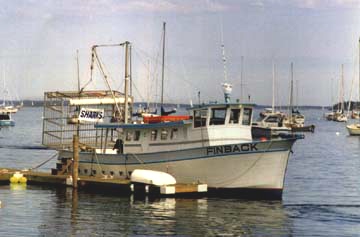
I wrote a story a while back for Offshore magazine about my experiences taking people out to swim with sharks. Well, not actually swimming with them. These were all cage dives, as you can see in the photo, with a cage that had no door -- instead, it had a hatch in the top -- to keep the braver individuals from being tempted to go nose to nose with the toothy critters.

(You non-marine oriented people take note: On a boat or ship, a door is a means of egress through a bulkhead. A hatch is a means of egress through a deck. Bulkhead = wall. Deck = floor. A boat can be carried on a ship. A ship cannot be carried on a boat. Unless it's a submarine. All subs are called boats.)

I got into this shark cage thing when renowned wildlife photographer, Bill Curtsinger, contracted me to take him around the Gulf for three weeks. Among our other explorations were three days filming sharks 30 to 50 miles off the coast. Back then there were a lot more blue sharks. If you go to Bill's site you'll see some of the blue shark photos he took while chartering my boat.

Having taken wreck and wall divers in years previous, the idea of cage diving had its appeal. Any captain will tell you there's always a bit of anxiety when divers are in the water. They kind of get spread out.

Divers not only get separated from one another, they don't always follow the anchor line back to the boat. If it's a drift dive, and there is no anchor line, the situation can be even more exasperating.

See the movie, Open Water. I'm not trying to scare anyone, just illustrate what can happen if you get overly adventurous. There are a multitude of stupid ways to die. Being left behind on a wreck dive because you wanted to swim to the edge of a perceived debris field is chief among them.

This is why cage diving has such an appeal to the captain who for years has taken divers to wrecks and walls. Divers in cage. Cage tethered to boat. In many ways, this type of trip, the shark trip with a cage, is the safest type of dive trip.

-seabgb

Sidebar:

A little note about watching out for the competition: Ten or more years ago, after I got out of the business, I put my cage up for a sale, A local captain who wanted to get into the biz called me up about it. I gave him a price and we made arrangements for him to come and look at the cage.

He came. He looked. He took measurements. Then he went home and built his own cage from my design. He stole my design and started his own business. The honorable thing to do would have been to call me up and hire me to do one hour's worth of consulting. For $50 to $75 he could have bought a lot of good will and more. Instead, he gets failing grades from me, and not one referral, ever. The guy is a retired cop, too.

I ended up selling the cage on eBay to a captain from Nantucket. The transaction could not have been more enjoyable. The buyer came up in a 3/4 ton Ford with his son and a friend. They made a day of it, cut the cage in half, and went home with the pieces tied into the bed of the truck. My cage was one solid piece, but they left it in panels so it could be transported easily and assembled on site.

Goes to show you the difference in people.

Monday, December 12, 2005

You're Not Suppose to Get Close


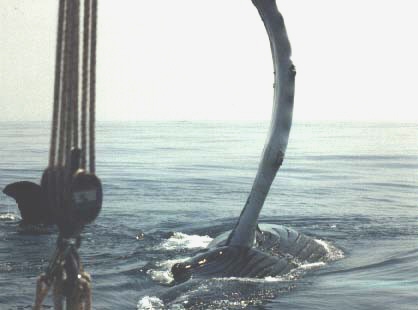
The Marine Mammal Protection Act prohibits vessels and their captains from getting within a certain distance of whales. But there is no law that prohibits whales from getting close to vessels, which, if you're lucky, is something they're known to do. Nobody knows why. Perhaps it's curiosity. Perhaps it's companionship. Perhaps it's something else.

This large humpback got within a few feet of our small boat when he decided to roll and flop around as if he were trying to work out a kink in his back or expel some gas. Don't laugh, In the past I've been alongside whales that have provided my passengers with a whiff of some very aromatic flatulence. Just when you think the air couldn't smell any worse, there's an unmistakable assault on the sinuses.

These are pretty smart animals. Maybe they do it on purpose.
-seabgb

A Little Too Much for the Little Boat


A Small Craft Advisory was in effect. Seas 4 to 7 feet dropping to 2 to 4 by afternoon. I figured it was probably OK for me to tow the little boat back to Rockland. All depended on how fast the wind dropped off.

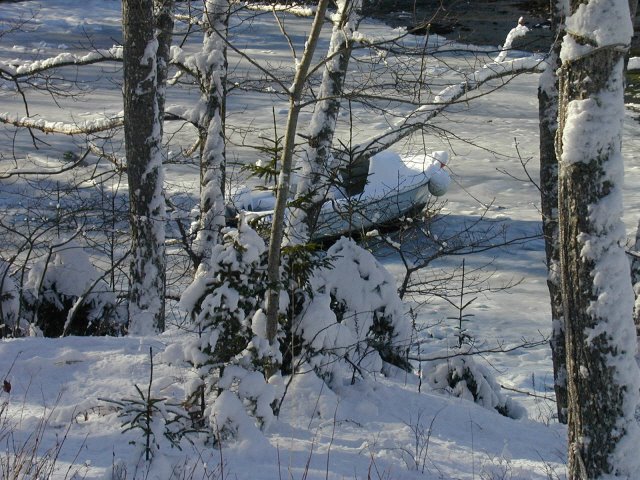
Ice was gone out of the cove so it was easy to row out to the outboard. Damn motor took forever to start. Must have stalled twenty times. I have no confidence in that thing anymore.

Finback was in no better mood. She clearly wanted to hibernate where she lay. Took six shots of ether and a jump from the outboard to get her going. (Bitch!) I dropped my good sweatshirt in the bilge. Forward pump was frozen, blew three fuses before I got it unstuck. Batteries were almost dead. My feet were already soaking wet from pushing the dinghy through the eel grass. I'd left my gloves outside in the truck all night and they were ice cold. All I had with me was a turkey sandwich on a hamburger bun from the Gig Store. Looked like mostly mayo. But -- it was now or never. Tide left me no choice. Couldn't get back to shore now.

I plugged in the laptop, rigged a tow line, and got underway. Logged my departure at 0950.

Seas in the river were just like you'd expect with 20 knots of wind and opposing tide.

Got through Port Clyde and around Marshall Point and headed toward Mosquito Island. That's when I took the shot above. At Mosquito, seas were all of six feet and breaking. Little skiff didn't like that at all. Wanted a picture at Mosquito but couldn't leave the helm. I'm pretty sure if I'd walked back to get a shot of the outboard, Finback would have yawed side to and the skiff would have swamped. I decided to alter course for Tenants Harbor, put the skiff on a mooring, and continue to Rockland without the worry of the tow.

Best laid plans and all that.

Fetched Rockland at 1400. At least my exhaust repair held.

-seabgb

Saturday, December 10, 2005

I Really Must Do Something With These Boats


1130

Dang, caught with my pants down again. I guess tonight I'll have to move the boats before the little one gets iced in and I can no longer get to the big one.

1630

Dark already. Sucks. Have to chop through the ice to get to the pointer. When I get there I find the boat out of gas so I row back through the ice and get the jerry can. Fill the pointer and start for Finback. Yamaha knocking from down low. Sounds like a connecting rod. Better take the dinghy along -- just in case.

On Finback . . . one of those pasty, sticky snows that covers everything. You'd think with the wind that blew, it wouldn't have been this bad. I hate this type of snow on the boat. Only thing worse is glaze ice. I'm sure that's coming.

Too much water in the bilge. Have to deal with that tomorrow when I get underway. For now, shovel her off as fast as I can and get back. Dinner with friends tonight. Already running late.

Get back to the mooring in the cove. Tying up the pointer. Kestrel flies over my head. I think I hear an owl in the woods. Must be a small one.

-seabgb


Friday, December 09, 2005

A Friend Heads for Brazil with a New Perspective

I'm at my Mom's cleaning up yesterday when I find this old clay piggy bank. It's nothing special but it has a single coin in it. I open the bottom and pull out what looks like a nickel. On closer inspection it turns out to be 5 Shillings from the Republic of Somalia. On the back is stamped: XXI CENTURY 2000 FOOD SECURITY FAO.

I place the coin in my pocket and go into town to run some errands. On my way back I stop for coffee and drop the contents of my pocket --including the 5 shillings -- into the tip jar.

Just then a friend I haven't seen in months walks in. The guy has a tour boat and restaurant business that failed last year. As a result he's hard pressed for cash. He tells me he's heading for Brazil to run a 125' supply vessel for the Tidewater Company. He chose that over the Gulf of Mexico and the Persian Gulf.

I say to myself: "Brazil, Gulf of Mexico, Persian Gulf -- Somalia! My coin!"

I go back to the counter and ask the guy if I can rifle through his tip jar. He shoots me a look but I ignore it. I dump the contents of the tip jar into my hand and search for my coin. My friend is mortified until I show him what I was after.

Holding it in his hand, he says: "It's like plastic."

"I know," I say. "I think it's aluminum."

He looks at the coin up close and reads where it says Food Security, then he bounces the coin in his hand a few times.

"Just when you think you have nothing," he says, "you're reminded of people who have less than nothing."

"That's why I wanted it," I add.

After we say goodbye I come home and do some research:

FAO is the Food and Agriculture Organization of the U.N.

The coin is a commemorative minted in Slovakia. It has virtually no monetary value.

There are 1789.78 Somali Shillings in one U.S. Dollar. (An Iraqi Dinar is worth more. Curiously, an Iranian Rial is worth almost five times less than a Somali Shilling. How is that possible? Says something about the situation in Iran.)

The average life expectancy for a male in Somalia is 46.36 years.

-seabgb

Wednesday, December 07, 2005

Moose Island


Actually, it's really called Monroe Island, privately owned, about 2-3/4 miles from Rockland. It isn't really known to have moose on it, but many years ago, it had one that came out every morning for about two weeks to sniff the air coming over the mainland. Clearly, the old boy had swum out to the island on the spur of the moment, then decided he didn't want to stay. Problem was, he'd bitten off more than he'd wanted to chew. Cold water. Long swim home. Lots of obstacles.

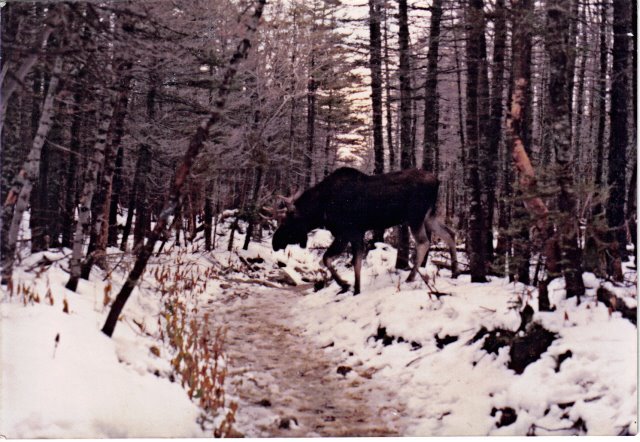
Moose in the picture above is not the one of the story. Moose above is one that charged me on a trail on Bigelow Mountain. He charged full steam, then went into a trot, then a walk, and crossed the trail behind me, which is when I snapped his mug shot.

Moose of the story is one I would see every morning on one of my daily trips to the outer islands of Penobscot Bay. Until the day he didn't show up.

I like to think he finally got up the nerve and swam back to the mainland.

-seabgb

Tuesday, December 06, 2005

Look! A Sea Shell!


That's my father holding up the sea shell. Me, standing behind Henry Ford. Yeah, that Henry Ford. This is after our chopper crashed in the desert. Dead chopper in the background. Probably nobody will ever read this and therefore nobody will ever ask me for an explanation. All the better.

Point is, this blog is dedicated to the sea. We're in the middle of the Sinai Desert, and my Dad is holding up a sea shell. Don't believe me. Check in Henry Ford's book, Henry.

-seabgb

Copyright © Bob G. Bernstein (seabgb) All Rights Reserved

Sunday, December 04, 2005

Picture of Me on Index Rock, Mt. Katahdin, Me.


This isn't exactly a picture that relates to the sea, but if you give me a minute, I'll find a connection. (For the most part, I just like the picture, as it reminds me of my more carefree and fearless days.)

Index Rock is on the Dudley Trail, a steep, boulder strewn climb up the north slope of Pamola Peak. The boulders are huge, and most of the climb is a hand over hand crawl. Very strenuous. At one section, the boulders are so large they form caves.

I used to go to Katahdin every year for three days to a week. When I first started going, at the age of thirteen, you could hike or climb all day and not see another soul. Those days are long gone. Katahdin, and the park it resides in (Baxter State Park), see many thousands of tourists and campers every year. August is probably the busiest month.

If you asked the park rangers what the increase in traffic has meant to them I'm sure they'll remark about the physical stress, i.e. erosion, litter, waste, etc. They'll also mention that many tourists are ill-prepared for a visit or hike in the park.

Indeed, this is the connection I was looking for.

Preparedness.

One of the worst things that can happen to a climber, and one of the most frequent of all mishaps on Katahdin, is getting stuck on the mountain after dark -- without a flashlight. You might as well sit down and wait until morning, because to go farther in the dark, especially down, is a recipe for disaster.

You would be amazed at how many people start climbing Katahdin without the basics, good shoes, enough water, a flashlight.

By the same token, you'd be amazed at how many people head out to sea without the same basics.

When I was running daily tours to the outer islands, it got to the point where I'd tell people to dress for winter. They would be stunned to hear this, or they'd just laugh. "What, you mean," they'd ask. "Like gloves and a ski cap?"

"Yep."

"But it's July."

"Trust me."

And we would get out there and the smart ones would have listened and they'd be in hats and coats and gloves, all nice and toasty.

I used to carry blankets on the boat but they tended to walk off by themselves. So then I started bringing my ratty old winter coats. Moldy, smelly, grease stained things that never, ever got washed. The kind of coat I'd lean on in the bilge to keep my knees from getting dirty or bruised.

People would come to me half way through the trip and say. "Do you have a blanket or something I can have to keep warm?"

I'd tell them no, but that they could wear this . . . and I'd hand them one of my coats. Nothing I liked more than to see that special guy or gal who disregarded my advice bundled up in one of my disgusting rags -- and lovin' every minute of it.

Hey, if you don't heed the advice of the professionals, smelling like a day old herring belly is a small price to pay.

-seabgb

Copyright © Bob G. Bernstein (seabgb) All Rights Reserved

Risk Assessment

(illustration by Sollars)

Finback is pretty protected up the river, but in a westerly gale the wind can kick up a nice little chop. There were probably three-footers rolling in when I checked the boat yesterday.

I took the Pointer, a 23' center console skiff with a 150 hp Yamaha. The little boat took spray over the bow and pounded the whole way out.

Tying up was a little tricky, getting underway afterwards trickier. The latter required a leap of faith, wind and seas tearing at the boat and painter.

While the little boat was tied abreast to the big one, it thrashed and bucked at its lines like an animal trying to break free of its chains. Even with substantial fendering, the two boats slammed into each other on several occassions.

To get Finback started I had to jump it off the battery in the Pointer, which meant running a 20' jumper cable across the rail and into the pitching and rolling skiff.

It all worked out. I got the big boat started, ran it for an hour. I would have liked to get underway, but. . . . Being by myself, tide ebbing, working against the clock and such, it just seemed like I was pushing the envelope.

I'm glad I didn't have to get underway. I'm glad my income, my very survival, no longer depends on getting underway in rough weather. So many others who work on the sea aren't as fortunate.

Not My Time

Several years ago I was hired to due a story on a highline tuna fisherman from Cape Cod. I won't use his real name, though I suspect many readers will know about whom I'm speaking.

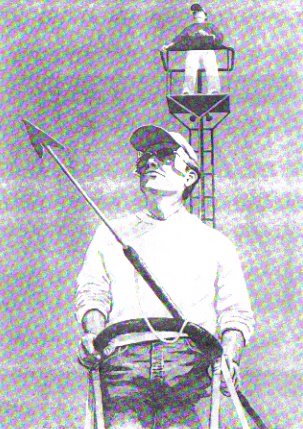
We went out early in the morning in his 31' BHM, aided by a spotter plane. The waters were rich with activity. Whales, dolphins, sharks, and huge schools of giant bluefin. We eventually stuck (harpooned) one at the end of the day. Fish dressed out at 850 pounds.

But that's not the point. Point is, for a good while, this fisherman and I were in the tower together, high over the boat and the water, probably 25' to 30' up. I remember feeling the tower buck, twitch actually, with every wave. It was an odd movement. I'd been in many other tuna towers and never had I felt that pecular type of motion. I mentioned this to the captain and he said he didn't notice it. He also said he'd had the tower extended recently.

After we unloaded the fish, after we put the boat to bed, this fisherman and I said goodby to each other and I travelled back home to Maine. I wrote the story, which ended up as the cover story that month. The fisherman was quite pleased with the way it came out, even though he never wanted his name used.

Two or three weeks later, the guy was fighting for his life in a hospital. What happened was, on another routine tuna trip, the tower collapsed. The guy and his mate were slammed against the rail, then dumped into the sea. The boat, of course, with no one at the helm, kept going.

Fortunately, their lives were saved by the quick thinking of other tuna fishemen in the area, who spotted the boat motoring around with its tower broken in half, and the good survival instincts of the captain, who, despite serious internal injuries, kept his mate afloat until help arrived. They two were eventually airlifted to a hospital.

As Luck Would Have It

When I was a little kid, about 12 years old, I went with my mother and brother to this house in the suburbs. While the others were inside, I went out to watch this guy with a spinning rod cast a small lure into the swimming pool. I watched for awhile, and then something really strange happened. I felt this tugging at my eye. No shit, this guy cast the lure across the pool and hooked me in the eye.

My mother -- who is now suffering from Alzheimer's and can't cook an egg or boil water without help -- took me up to the bathroom and removed the hook from my eye. The barb had gone through the eyelid, in and out, but somehow, miraculously, did not penetrate the eye itself.

I think about luck all the time. I think I was lucky it wasn't me thrown into the sea on that tuna boat. I think I'm lucky I have both my eyes. I can think of dozens of other times I was lucky. And I wonder if I'm running out of luck.

A friend of mine, ship captain and pilot, a guy I worked with as captain of the pilot boat, was interviewed for a story in a local newspaper. The reporter asked him what skills or qualities were needed by a pilot. He said: "After the obvious ones, seamanship, navigation, etc., the most important quality is luck."

-seabgb

Copyright © Bob G. Bernstein (seabgb) All Rights Reserved

Friday, December 02, 2005

The Boat Dog

(another article by Bob Bernstein originally published in Offshore magazine in one form or another)

Ever see a pooch on the foredeck of a skiff, nose pointed forward, ears flapping back against his head, his owner at the helm steering for some distant locale? Ever watch a dog trying to communicate with a mackerel flopping around inside a five-gallon bucket? Yep. There's no doubting it: Dogs love the boating life.

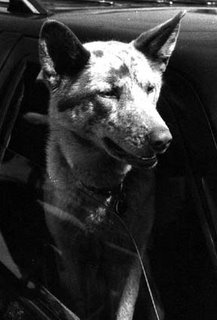
Mine does, anyway. Put her on a boat, any boat, and she'll make Sir Francis Chichester look like the King of the Dirt Farmers. Go ahead. Pooh-pooh a dog's brain for being mostly tuned to the business of sniffing, i.e. figuring out the subtle differences between a squashed jackrabbit on I-95 and a half-cooked herring belly lying on the lazarette hatch in the noonday sun. Scoff all you want. There's more to those aromatically challenged doggie synapses than you think. Deep within their fist-sized masses of gray matter lies enough cognitive ability to understand what 90% of pleasure boating is all about. That's right, I'm talking about a dog's two favorite things in the whole world: Eating and Sleeping.

My dog, Bullitt, named for the movie of the same name starring Steve McQueen -- if you saw me chasing after Bullitt when she was a puppy you'd understand why -- is a virtual sleeping and eating machine. I used to run bird and whale watch trips, and during the eight hour steam out and back, she was in canine heaven. She'd sleep from 7:00 am to around 11:00 am, then arise like a Phoenix out of the ashes when the distinctive wrinkling of a sandwich wrapper would roust her from her reverie. (It's a miracle of nature and a proven fact, tested I believe on the Bonneville Salt Flats, that a dog can hear a person opening a can of Vienna Sausages from five miles away.)

Listening to people eat is one thing, joining in is another. Everyone knows, a daily diet of human food is no good for a dog, and I honestly tried to keep the Bullie dog on the straight and narrow. But no matter how much I insisted over the PA for my passengers not to feed the dog (Attention on deck! Please come to the wheelhouse and pick up doggie biscuits if you want to feed Bullitt.), people just couldn't resist. There was this one time I came out the port side door of the cabin, turned aft, and found her standing over a 12 inch Italian Hoagie. Didn't that get my goat. Not only was she eating the wrong kind of food, she was eating better than I was.

However, life aboard the boat wasn't all subways and siestas for good old Woolly Bullie. A few years ago, I had a group of whale watchers southeast of Seal Island National Wildlife Refuge. We were busy eyeing a pod of four finback whales when a fifth whale showed up. This fifth animal was a sei whale, and it was much more active and curious about the boat and the people on it than were any of the more standoffish finbacks. The sei would charge, then, five feet from the hull, dive straight down. Ten seconds later it would surface on the other side. It continued this form of play for 30 minutes or more. And every time it surfaced, it would let out a massive breath of fishy-smelling spray.

We were all running around the deck, following the whale. We'd watch it charge the boat, then see it dive headfirst into the depths. Visibility was more than 50 feet, and we could see nearly the whole length of the whale as it turned gracefully downward and disappeared with one or two massive swipes of its tail fin. Quite the spectacle, except for one thing. . . .

The dog found the whale -- how should I say it? -- irritating. Every time the whale surfaced and blew, Bullitt would run willy-nilly around the deck whining and howling like a Scotch banshee. All I could think of was to pick her up in my arms and show her what the commotion was all about. In retrospect, my effort compared similarly to putting out a small grass fire with a pail full of gasoline. Instead of howling and running around on deck, the dog dug her claws into my shoulders and howled INTO MY EAR! Now this is something I'm more than a little used to given that I spend a good deal of time doing the exact same thing during thunderstorms, fireworks celebrations, and those unfortunate times when duck hunters venture too close to my house on Watts Cove. But I think the whole affair probably looked to my passengers like some form of sadomasochistic torture.

There was one other whale encounter Bullitt took exception to and it happened during a beautiful, flat calm day in July. We were cruising southeast through Maine's Penobscot Bay. I had a group of editorial and production staff from a national magazine aboard. when we spotted what looked like the inner tube from one of the space shuttle's wheels floating on the surface. We closed the distance, and the situation became clear and somewhat desperate. It was a minke whale, and it had gotten itself tangled in lobster gear, so much so that it was anchored to the bottom by twenty to thirty pairs of traps. The tide was flooding, and the animal was already tired from struggling to stay afloat. It also had a helluva sunburn.

To make a long story short, I maneuvered close. Then, with a sharp knife in my hand and the whale's tail hauled nearly to the boat's rail, the men aboard hung me over the side by my feet, and I cut the animal loose. I'd like to say it winked or nodded in appreciation but all it did was swim off and dive, then give us a nice big blow about 30 minutes later. Minke whales don't ordinarily have a visible spout, so maybe this was its way of saying, Thanks. Anyway, during the whole incident, Bullitt never veered more than three inches away from my right foot, except when I was being hung over the side, at which time she ran around deck and howled and whined like a Scotch banshee.

Just so you understand, Bullitt doesn't act this way with all whales. Of the dozens upon dozens of whale encounters we've had aboard the boat over the years, these were the only two that elicited such a response. Maybe she was scared. Or maybe, as I like to think, she was just trying to relay some form of whale communication to us less empathetic humans.

Pets are like that. They can communicate with other members of the animal kingdom in ways us humans will never understand. For example, we had a transient chocolate lab at that marina that liked to run up and down the docks barking at the seagulls, not the ones on the dock, mind you, but the ones flying overhead. Was he challenging them? Warning them? Or was he trying to tell us something? Your guess is as good as mine.

Another lab I knew, a yellow one named, Nell, liked to commune with the fishes at the most inopportune times. Billy Soltz, my best friend from high school, and his family, had a 17' Boston Whaler Montauk that we'd run back and forth between Bayport and Fire Island on Great South Bay. Once, when we were cruising along at about 30 knots, the Soltz's dog, Nell, just up and jumped overboard. We turned around and found her happy as a clam swimming in circles in the middle of the bay. After that we knew well enough to keep a watchful eye on her as well as a tight grip on her collar. But at speeds over 15 knots, her beady little eyes were always peeled to the wake, and her whole body shook with the urge to plunge into the sea.

Chasing birds, diving into the ocean, receiving psychic messages from whales, and dreaming of deck loads of hoagies, add up to tons of boating excitement for dogs. And even if they don't get the chance to do something wonderful like take a quick slurp out of the bloody chum bucket when you're not looking, there's no doubt they'd rather be by your side on the boat than anywhere else on the planet.


A Note About Pet Safety Aboard the Boat

First thing you want to do is get a good pfd for the pet. This is especially true for people with flush deck boats, and, particularly, for people with sailboats. Also, if you have a boat like this, it's not a bad idea to consider safety netting. My boat, Finback, has a 40" bulwark, so there's virtually no chance for my dog to jump overboard. However, as Billy Soltz and Nell can attest [see story], sometimes the urge to make a splash can be overwhelming. For example, when I get close to the dock, I always assign someone the job of holding onto the dog, because I don't want her vaulting for the dock prematurely.

In addition, at night and in rough weather, it's a good idea to clip a safety light to the dog's pfd. Keep it turned on during the passage and it will insure that if the dog has an unfortunate accident and falls overboard, you'll have the best chance of finding it.

Also make sure your pet has plenty of water. Dogs get dehydrated just like people, and they get seasick, too, which further dehydrates them. There's not much you can do for a seasick dog, except give it someplace comfortable to sleep where it won't slide around or get hurt by things flying off of shelves and out of cabinets. Usually a dog will seek out it's own place. If it does, make it comfortable and safe there. Eventually, seasickness will pass, and many dogs that get seasick in the beginning, adjust accordingly and stop getting seasick altogether.

Dr. Glenn Yovino, at the Harbor Road Veterinary Hospital in South Thomaston, Maine, has a few more suggestions:

1. Make sure the animal's pfds are appropriately sized. This is key.

2. Acclimating the animal to the boat before embarking on a long trip. Let them get familiar with the boat, the dock, the skiff, and short trips.

3. If you're going out of the country, do your homework. First, you need to make sure it's allowed. Second, if it is allowed, you have to get the paperwork in order.

4. Seasickness can be an issue. Some people think the dog should be sedated, but Dr. Yovino says dogs do best with their wits about them. Again, acclimate the dog to short trips first. And, if you're expecting heavy seas, Yovino suggests skipping a meal.

5. Don't forget to always have plenty of fresh water available.

6. Most dogs can go twelve hours without urinating, but Yovino suggests trying to get the dog to urinate every four hours. Remember that a house-trained dog needs to be retrained to go on a boat. They need to be praised for doing what they think is the wrong thing. If you're not going to stop every four hours and walk them on land, try and get them to go on deck. And, if you suspect they're holding it in, put the leash on and give them a walk around deck just like you would do on land. Put some paper down and see if that'll work. When they finally go, make sure you praise them. And don't worry, they'll know the difference between the deck and your living room.

7. Last but not least, Yovino cautions boaters to be very careful with young animals. Don't subject puppies and/or kittens to long trips or rough weather.

-seabgb

Copyright © Bob G. Bernstein (seabgb) All Rights Reserved
Thursday, December 01, 2005

Ships Under the Sea

Embarrassment at Castine

by Bob Bernstein

(originally published in Offshore magazine)

As a diver and amateur treasure hunter, I've always been fascinated by Maine's maritime history, particularly as it relates to things that have filled with water and sunk. But in 1982, my interest took a more pro-active turn when I decided to open a dive boat business. Suddenly I needed wreck sites for my customers. Working from the deck of a 30' lobsterboat, my friend, Carl, and I started hunting the mid-coast area from Islesboro to Damariscove Island off Boothbay Harbor. Lo and behold, we located eight sunken ships dating from the turn of the century to the mid-fifties.

It sounds like we accomplished quite a bit, but actually it wasn't that difficult a task. Maine's coastline is peppered with thousands of islands and countless numbers of underwater hazards. Truth is before NOAA and the U.S. Coast Guard started marking things, this was not the safest place in the world to explore. Captains lost their boats left and right to Maine's ledges and shoals, and some say there are over 3,000 shipwrecks here.

Maine's Most Infamous Wrecks

It was not one of our Country's proudest moments. In fact, it cost two Americans their commissions and honor and sent twenty-nine ships and 500 men to their graves. Paul Revere -- considered by so many to be a hero of the revolution -- was court-martialed as a result.

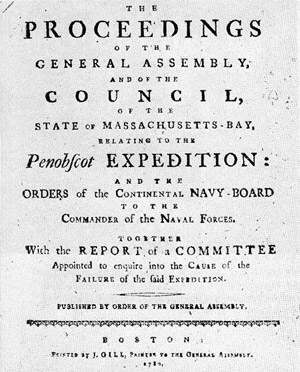
I'm talking, of course, about the battle of Castine, where, in 1779, a fleet of American warships, 39 in all, disgraced the flag and their compatriots while trying to take Fort George from the British. Here's what happened:

Six American navy ships, 13 privateers, and 20 troop transports -- with over 1200 men -- set sail from Boston in July of 1779. They arrived in Castine to find the fort guarded by three British warships and about 500 troops. For some unexplained reason, the Commander of the American fleet, Captain Dudley Saltonstall, chose not to attack with his ships. Instead, he put his troops ashore and laid siege to the castle from land. The battle lasted 21 days, after which the Americans were repulsed and forced to retreat back to their boats.

Not soon after the American troops boarded their vessels, a British officer. Sir George Collier, arrived with six of His Majesty's warships. The British vessels entered the bay from the south and apparently their appearance placed Saltonstall and his officers in such a state that the American commanders ordered their warships to break ranks and flee to the north. When Collier saw the transports abandoned and left drifting, he began to open fire on them with his cannons.

But the disgrace of Saltonstall's opening action was just the beginning. As some of the transports came to rest along the banks, troop commander General Peleg Wadsworth gave orders to set up a line of defense along the river's edge, presumably to provide cover for the fleeing American warships. His artillery officer was none other than the renowned arms maker, silversmith and metalworker, Paul Revere. Ironically, Wadsworth's grandson, Henry Wadsworth Longfellow, would later immortalize Revere in a poem. But on this day, in July of 1779, Revere proved himself unworthy of such accolades. In violation of Wadsworth's instructions, he scuttled his artillery and munitions into the sea and began a forced march with his men back to Boston.

Meanwhile, Saltonstall and his other captains tried to sail their vessels out of reach of the British Navy. The majority went up river. One, the Defence, tried to make its way to sea. None succeeded in eluding their pursuers, and all were scuttled and burned by order of their commanding officers.

Pickled by Nature, Preserved by Man

Ten years ago, a friend and I dove on two vessels that had been under Penobscot Bay for 100 years. One of the vessels, a 212' three-masted schooner, stood square on its keel as if she had filled with water while on her mooring. Her masts had fallen down, her deck house was gone, and the bowsprit had broken in half, but everything else was in remarkably good condition.

My dive buddy went inside first. With visibility down to a foot or less, he swam carefully through the deck opening and down a set of steps. Inching his way forward, he made his way to the galley. First there was an iron cook stove, then, next to the stove, a crockery jug. Finally, right next to the jug, standing upright as if someone had just put it there . . . a half-full bottle of cooking sherry. All this in a ship that had sunk at the turn of the century.

Scientists believe that a combination of certain sediments, low salt content, still waters, and an absence of wood-eating marine organisms, help keep shipwrecks intact. The wreck my friend and I visited certainly bears this out, but so does another more important find, the wreck of the Defence, discovered by archeologists in the early seventies in a cove in Stockton Springs.

The Defence -- the ship that tried to escape to seaward but eventually got torched by her captain, John Edmonds -- was partially salvaged by a team of scientists working for the State. While some of her artifacts were preserved and placed on permanent display at the museum, the bulk of her lies on the bottom. In fact, because saving sunken treasure for all eternity is such a time-consuming and expensive process, the State decided to leave most of what they found right where it was. They brought stuff to the surface, photographed it, cataloged it, put it in a big net, then gave it back to the sea. Why? Because the Upper Penobscot Bay is the perfect pickle jar.

Paul Revere's Silver Collection

I've toyed with the idea of searching for Paul Revere's treasure ever since that day my friend and I found that half-full bottle of cooking sherry. My interest is further peaked whenever I visit the Defence exhibit in Augusta. But there are three reasons my salvager's sea bag remains empty: (1) Silver doesn't have the staying power of gold, a remarkably everlasting metal; whereas the Penobscot River and Upper Bay are the perfect pickle jar, silver is not the perfect pickle; it doesn't take much to destroy any or all of its filigree, and it has a very low resistance to surface corrosion. (2) The State has laws that prohibit private citizens from removing historical artifacts from State waters, and (3) Revere's collection supposedly went down on the Spring Bird -- scuttled and burned somewhere north of Hampden.

Hampden's just south of Bangor, but way, way, way upriver. This means the person who succeeds in finding Revere's sunken treasure will have to dig through over 200 years of accumulated sediment. The ship might be under 50' of mud and silt. Or maybe the captain and crew of the Spring Bird removed the treasure, carried it inland, and buried it somewhere between here and Boston. Perhaps they stole it from Revere and divided it between themselves. Or maybe Revere came back to Maine and dug it up himself. Nobody knows for sure.

There are at least two certainties though: History remembers Revere for his ride through the Commonwealth and not for his cowardice or insubordination at the battle of Castine. For all intents and purposes, people seem to prefer it that way.

-seabgb

Copyright © Bob G. Bernstein (seabgb) All Rights Reserved