Saturday, January 27, 2007

Fire Suppression Systems

Express Shuttle II v. Ring Power-3
erosfaust


If necessity is the mother of invention, one of its grandkids is bound to be a screw-up. Case in point:

Non-automated fire suppression systems went into use in textile mills in New England as early as 1852. Twenty years later, an engineer from Massachusetts came up with an automated system, and two years after that someone else, a guy named Henry S. Parmalee, made a sprinkler head that really worked. In 1874, Parmalee installed what was probably the first functioning fire suppression system into his piano factory. These, of course, were all mechanically operated sprinkler systems.

While we still have automated systems that work purely by mechanical means, using principles of pneumatic or hydraulic expansion, many, if not most of today’s systems, particularly those on boats and ships, rely on an electrical circuit for fire detection. Herein lies a serious problem, because without early warning capability, the vessel’s crew and passengers are at the mercy of lady luck.

In October of 2004, a fire destroyed the Express Shuttle II, a 65’ passenger vessel operating out of Port Richey, Florida. Following an investigation of the incident, U.S. Coast Guard officials decided to take a long, hard look at custom-engineered fire fighting systems. Systems using DC electric detection components were most suspect.

What happened aboard the Express Shuttle was not atypical of many engine room fires. A high-pressure fuel leak in one of the boat’s two Caterpillar engines sprayed fuel on the engine’s hot manifold, causing the fuel to ignite. Instead of manually triggering the fire suppression system, the crew (a captain and two deck hands were aboard as passengers had just previously disembarked) decided to fight the fire with hand held extinguishers. The fire rapidly became unmanageable and the crew had to abandon ship. Vessel was a total loss.

Coast Guard Investigators determined the loss was due to three factors: poor maintenance of the fuel feed line to the number five cylinder; inadequate crew response to the emergency; a non-functioning fire detection system; in fact, the fire and smoke alarms on the vessel never sounded.

For further reading, try the full NTSB Accident Report on the Web: http://www.ntsb.gov/Publictn/2006/MAR0602.pdf. And note the following U.S.C.G. recommendations:

1) A panel light should notify an operator of a fault or break in the fire detection circuit.
2) Detectors should be UL, FM or LPBC approved.
3) The system should be testable by smoke or heat.

-seabgb

Wednesday, November 29, 2006

Don't Forget to Update Your Charts!

Sorry I haven't been very attentive to the blog of late. Pressing problems at home. Work on the the boat. Yada-yada. I know. Who cares? But here I am -- with some info on mapping software for you to stew on.

I use Maptech's Offshore Lite, a great package that comes bundled free with their Chartbook. Basically, it's an abbreviated version of their professional navigation software. You get digital versions of all the charts in the Chartbook but not all the features of the Nav software. For example, while you can track vessel's position with an integrated GPS, you don't get the full save and store capabilities of Offshore Pro. You don't have access to bathyspheric and other data, like tide info. You can't place a mark or waypoint on your vessel's position at the touch of a button, nor can you tie into an autopilot, or transfer routes and waypoints to and from your GPS. As I said, it's a great little tracking and plotting program that does the job and more. However, the more you use it, the more you will want to buy the pro version. And if you're doing any kind of commercial work, whether it's fishing, towing, whatever, you'll need Pro.

I'm currently doing an underwater survey using a magnetometer and forward-looking fathometer. I collect event data using proprietary logging software, and I create event markers on a C-Map cartridge being displayed on a Hondex plotter. I also take the raw data output from the Mag and manually transpose it to the Maptech charts in the form of event markers. In other words, I use the Hondex to re-locate targets, and the Maptech chart -- a NOAA chart with real NOAA symbols -- to chart my data. It's not an ideal situation because even though I have the redundancy aspect working in my favor, I'm doing a lot of extra work. Why not just keep a running plot of event markers using the Maptech software? The answer: Because Maptech Lite can't do it. You need the Pro version. I tell you this to give you an idea of the advantages and disadvantages of both.

The big advantage of Maptech Lite is that you get real-time tracking capability on a NOAA chart for free, or what amounts to 'free' when you buy a Chartbook? You still need paper charts to be legal, so why not get the Chartbook and play with Offshore Lite. It's free?

-seabgb

Sunday, October 29, 2006

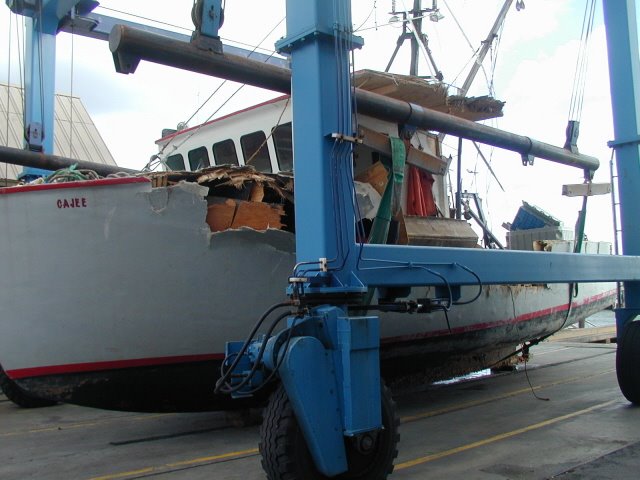
Saturday's Storm

Those who prepared for it:


And those who didn't:


Results of 63 Knots at the Rock. 15' to 20' seas.

Wednesday, October 11, 2006

Tuesday, October 10, 2006

How to Re-Document Your Own Vessel

Here's how you can save a little money by doing the Purchase and Sale Agreement and the re-documentation yourself . . . assuming you have no broker, bank, or other mortgage interest involved.

First, get the Name and/or Official number of the vessel and get the Official Document info on line. Next, take this info and use it to fill in the blanks in a standard Yacht Purchase Agreement. You can find one of these online by doing a Google search for "Yacht Purchase Agreement." Pick one that comes in a PDF Format so you can fill in the blanks on your computer. Include names of purchaser(s) and seller(s), addresses, purchase price, boat name and official number, description of vessel, and attach a list of the equipment that comes with the boat, right down to galley utensils if there are any. No SS#s are needed here. Also list the contingencies of the sale, i.e. survey, financing, sea trial, etc.

Remember, with these online PDF files you can't save the document, so print out as many copies as you want. There should be one for you and the seller, and one for each and every buyer and/or seller, in the event there are multiple buyers and sellers. Each copy should be signed and dated by both parties, and each one notarized. Again, make sure you have all the agreed on conditions of sale, e.g. survey, loan, sea trial, things to be fixed, etc.

Now go to the USCG National Vessel Documentation Home Page and download the appropriate forms, first and foremost of which is the request form that will tell you what if any liens there are on the boat. This is the Abstract of Title request. Send this in first. You should have results in a few days. If there are any outstanding liens (preferred mortgages on the boat, these will have to be satisfied or released before a new document can be issued. Applications for Satisfaction of Mortgage, and forms for filing of mortgages, are also available on line at the link above.

For re-documentation, you need a notarized Bill of Sale, a Satisfaction/Release of Mortgage statement for each mortgage (signed and notarized by a bank official), an application for Filing of Mortgage (if in fact you're financing with a mortgage company or assuming someone else's mortgage), and the current Certificate of Documentation signed over to you.

All these blank forms are available at the NVDC Site listed above.

One final note: The procedure for documenting a new vessel is slightly different. You have to prove ownership and citizenship, which means you will need a builder's certificate and Form 1258, where you can provide your social security or tax I.D. number.

-seabgb

Sunday, October 01, 2006

After the Purchase....

Every day Moonfish gets a little closer to being ready for sea. I've re-run and rerouted wire, moved electronics, bolted the electronics console in place, replaced worn hose, checked and replaced hydraulic lines, added chafing gear where needed, clamped and wire-tied loose hose and wire, removed wire that went nowhere, tightened the engine belt, built a platform at the helm, checked and replaced engine zincs, replaced rudder zincs, waterproofed some of the windows and hatches, fixed broken fittings, tightened loose screws and bolts, and generally attended to things the previous owner would have done himself had he kept the boat.

For the record, it costs $121.00 to do your own paperwork. This includes an Abstract of Title and the application for redocumentation. A service would charge $300 to $400. I had the paper work done in about a half hour, although I ended up making an unscheduled trip to a bank in order to track down a second satisfaction of mortgage I didn't know about. Took about an hour an a half of my time. Start to finish, I had the the new document in my hand in a week. The guys at the Documentation Center in Virginia work pretty fast.

I needed a marine surveyor for the insurance company. I've had some bad experiences in the past with surveyors, but this guy was OK. In fact, I knew him years ago when he was with the USCG Marine Safety Office. He was one of the inspectors who would visit Finback twice annually for her hull and safety inspection.

Surveyor was Mike Whitten, of Bucksport, Maine. Take my word for it. If you must have the boat surveyed, for either an insurance company or a bank, make sure the person doing the survey knows what the hell they're doing. At $15 a foot, you want to feel like you're getting something more than just a chance to shell out a fortune in insurance premiums. I can't say the money I spent on the survey would not have been better spent on a new EPIRB, which I have to buy anyway, but at least I had a chance to review the boat's systems and condition with someone I respected. Would I have voluntarily chosen to have to boat surveyed had it not been required by the insurance agent? Not on your life.

The only thing left for me to do to be completely legal is to have the new name put on. Both bows and stern. This is kind of a conundrum because I have some gelcoat work to do on the transom, right under where the lettering will go. It's a Catch-22. I need the lettering and name so I can be official and legal and get to work, but if I put the lettering on before I fix the gelcoat, I'll just have to re-do the name afterwards. Oh, well, not much I can do about it.

-seabgb

Sunday, September 24, 2006

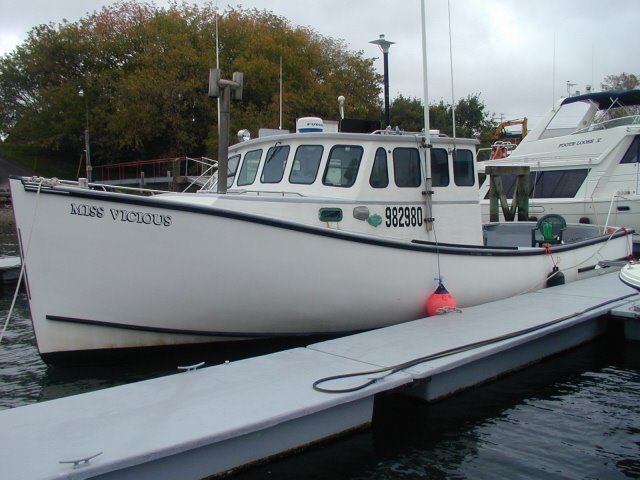
Interesting Boats: Fishing Vessel Miss Vicious Soon to be Moonfish

At 2:54 PM on Friday I became the official owner of the Miss Vicious. Yesterday, in 20 knots and 5 to 8 foot seas, I steamed the boat from Round Pond to Lermond Cove in Rockland, where it will stay until I can fix those things that are broken.

Boat is fat bellied, yet fast and nimble. Beast-like. A one of a kind, in boating parlance, a one-off. I have never seen another boat like it, and I have seen a lot of boats. (I wrote a boat building column for 15 years.) Unfortunately, its current moniker, Miss Vicious, won't work for me.

So how does one go about choosing a boat name? For one thing, mariners consider it bad luck to change the name of a boat, which is why if you're going to do it, you better do it right.

Henceforth, Miss Vicious will be known as MOONFISH.

The Moonfish is a round fish, deep as it is long. Not a schooling fish. Prefers its solitude. Old time fishermen used to consider a good luck fish. Instead of selling them, they would give them away as a gesture of good will. Mostly a Pacific and west Atlantic species, it is a rare breed for these parts.

An added bonus is that the fish is a member of the jack family. My grandfather was named Jack.

-seabgb

Wednesday, September 06, 2006

Steve Irwin R.I.P.

I offer the following to all the critics of the Croc Hunter:

Marty Steuffer. Marlin Perkins. Jacques Cousteau. Jeff Corwin. Jack Hanna. The list goes on and on. All of these guys, even the most light footed of them, manipulate their encounter with the wild. They have no choice. Baiting, and even lighting, is a form of manipulation. As the physicist Heisenberg postulated: The act of observation in and of itself changes that which is being observed.

I don't consider chasing a snake or croc and trying to grab it by the tail to be cruel, provided there's a reason for it. For example, whenever I see an animal (cat, dog, deer, moose, bear, etc.) lolly gaging on the side of the road, I always stop and chase it back into the woods. I may even throw sticks and rocks at it to get it farther away from the road. Sounds cruel but I'm doing it a favor. I'd much rather see it running away from me in fear than lying in a pool of blood on the pavement.

When the government was trying to establish rules for whale watching in US waters, they sought out the advice of scientists and environmental groups. Originally they were thinking of a 500 meter limit. But the whale watch boats and environmental groups and even the scientists protested, saying they needed to get closer. Their argument was that the need for public awareness as brought about by professional whale watch operators superceded the potential risk to the whales, which was really minimal compared to the risks posed by other commercial traffic.

So, right or wrong, there's a precedent. Interference and observation versus leaving them the hell alone. Most conservationists will agree, it's too late for the latter.

Meanwhile, in terms of animal reactions, I think the instantaneous animal response (what happened in Irwin's case) is not what happens when animals are threatened. It's what happens when the animal is surprised. It sounds like semantics but I think there is a difference. Threatened animals respond by posturing or testing the threat. A snake coils and flicks its tongue. A bear charges and rears up. A dog snarls. Animals run from threats they know they can't handle. They attack those they know they can handle. Until they sense which is which, they're pretty tentative. Of course, the more you screw with them, the more unpredictable they get. If you step on a rattlesnake, you're going to get bit. And, when it comes to wild animals, nothing is certain.

Once while filming blue sharks here in the Gulf of Maine I started handing feeding the sharks whole herring from the side of the boat. There were approximately sixty sharks around the boat at any given time, swimming around in a big circle. I would hold a herring over the side of the boat, and a shark would swim close, tilt his head, roll his eye lids up, open his mouth, and I'd drop the herring in. I did this for about a half hour and didn't stop until the two cameramen came back in the boat for lunch. We were sitting in the boat's cockpit enjoying lunch, with me sitting on the washboard, same place I was when I was feeding the sharks, when this one shark lifted himself three feet out of the water and snapped at the sandwich in my hand. I have personally caught a couple of hundred blue sharks and I have never seen a blue do that. After that experience we all ate our lunch more in the center of the boat.

I didn't know Irwin or know anyone who worked with him, but it seems to me that what you saw on TV and film is what there was to see. Nothing hidden. Unlike so many others in this business -- even Jacque Cousteau, who was notorious for stacking the deck. Oh yeah, and we should point out that unlike Irwin's place in Australia, most croc and alligator farms around the world make their money harvesting skins, not tourism and public education. (Actually, I'm not positive about the last statement, but I'll bet dollars to donuts it's true. Anyone who knows for sure can state one way or the other in an email to me.)

Finally, it seems there's an abundance of real sadness and hurt among those who worked closest to him. That says a lot.

Steve did indeed put himself in danger. He took risks. He chased and caught a lot of wild snakes by the tail. In fact, he had life by the tail too.

Some will say this was nature's way of getting back at him. To them I say bull. This was Steve Irwin's last lesson to people about the wilderness. And I'm sure he would be the first to say: When it comes to the natural world, anything can happen.

Crikey!

-seabgb

Thursday, August 31, 2006

Exemptions for Canadian Built Fish Tenders in Maine

A minor amendment to the Jones Act appears to give Maine fishermen some regulatory leeway. The new revision, signed into law on July 11, 2006, provides an exemption for Maine fishermen who want to use a Canadian-built vessel to transport fish and shellfish between locations within the State of Maine.

Prior to this change, fishermen could use a Canadian-built vessel of less than 5 net tons to engage in fishing. However, they could not transport merchandise, or any product, including bait and lobster, port to port.

This revision applies to Maine and Canada only. The rest of the U.S., and vessels built in other countries, are not parts of the deal.

I say deal because you have to wonder how this all came about. Not too long ago a local lobster and bait hauling company (Drisko Lobster) ran afoul of The U.S. Bureau of Customs and Border Protection. CBP cited Drisko for violating the Jones Act for using a couple of Novi boats to haul bait and lobster back and forth from the islands to the mainland. Senator Olympia Snow (R, ME) got involved on behalf of the operator, who gave up his business as a result of the final adjudication, which came in against him on September 20th of 2004. Regardless of the immediate outcome of the case, it now looks like the law Snow wanted changed got changed -- but only as it applies to Maine fish haulers like Drisko. The change does not exempt new builds, replacement builds, or vessels running salvage, other cargo, or passenger operations.

The revision, as it stands, addresses Maine vessels under 5 net tons that have engaged in the transportation of fish or shellfish before January 1, 2005. The owner of the vessel must be a U.S. citizen and also must be operating the business pursuant to a valid wholesale seafood license that was issued by the State of Maine prior to the January 1, 2005 cut off. Finally, the owner must submit an affidavit to the Coast Guard certifying adherence to the above conditions no later than 180 days from July 11, 2006.

No matter what you think of pork barrel politicking, you have to tip your hat to Senator Snow from Maine. Somehow she managed to bulldoze a tailor-made change into the most hallowed Jones Act, a piece of legislation that was carved into virtual stone over 86 years ago.

-seabgb

Friday, June 30, 2006

Still More on Ethanol Blended Gas

Remember that article in the Wall Street Journal I mentioned earlier, the one that quotes Chuck Fort from BOAT/US? He said, ". . . ethanol is a powerful solvent." After thinking about this for awhile, and after reading an NMMA (National Marine Manufacturers Association) report, I came to the realization that his statement is a little misleading. In fact, ethanol isn't any more of a solvent than grape juice, or, for that matter, gasoline.

The problem isn’t that ethanol is a solvent, it's that it is incompatible with butyl rubber (e.g. O-rings and hoses) and a certain chemical known as di-iso octyl phtalate, a plastisizer used in fiberglass resin. It also scrubs the protective oxide layer off of aluminum and is electrically conductive. In phase with gasoline (meaning all together as one system), and in blends of 10% or less, most experts will say fegetaboutit. But as I said before, ethanol has this ugly habit whereby it sticks to water more than gasoline. In other words, ethanol will hook up with the condensation in your fuel tank over the gasoline there every time. When it does this, it sinks and concentrates at the bottom of the tank.

So what? So you might have ethanol and water at the bottom of the tank? Big deal. Well, in a fiberglass tank, the ethanol invades the pores of the tank, releasing some of the phtalates. These enter the combustion process and end up forming heavy black deposits on intake valves. That's the theory, anyway, based on analysis of Connecticut valve crud, which shows up as di-iso octyl phtalate.

Aluminum is another story. An oxide layer protects aluminum. No oxide layer. No corrosion protection. Ethanol and water are electrically conductive, so you have a galvanic issue inside the tank to worry about.

Hope this helps.

-seabgb

Monday, June 19, 2006

Interesting Boats: Have Boat, Will Travel. . . .

Every so often a boat comes up for sale I feel I need to own. Fortunately, it's either priced out of my range, or common sense gets the better of me. The industry trade paper Boats and Harbors is chock full of broken dreams for sale.

For the record, here are two pictures of two truly unique boats. Not sure where they are today, or even if they are afloat:

Maagen

Inspektionskutteren MAAGEN ses her med den oprindelige 40 mm kanon
placeret på fordækket.

(Foto fra Orlogsmuseets arkiv)


Seven Seas


-seabgb

More on Ethanol Blended Gas


Here's a follow-up on the initial post, which you can find below this one.

Based on reports from boaters in Connecticut and New York, where ethanol-blended gasoline has been in use for over a year, the situation can indeed be problematic. For people with newer boats and engines, the problem is mostly confined to contamination and phase issues. In other words, when water is introduced into the blend, the ethanol gets out of phase with the gas and into phase with the water. (In phase means the two chemical constituents are combined into one system; out of phase means the two parts have separated into individual components.) Once the ethanol and gas have gone out of phase, the water and ethanol combine and settle to the bottom of the tank, leaving a reduced octane gasoline floating on top. In addition, because the ethanol is a solvent, it scours debris from the interior walls of the fuel tank, which causes contamination.

Some people (namely, Chuck Fort from Boat/US), are still suggesting people with older boats consider replacing their fiberglass and maybe even aluminum fuel tanks. I'm still not sure why this is an issue for older boats and not newer boats with the same type tank. I need more info -- like what material is it in the older fiberglass fuel tank that makes it more susceptible to ethanol corrosion. Are they talking about polyester versus vinylester resin? Epoxy resin? Is it the type of fiber we're talking about? The layup? What? Why don't they just say what the problem is? Clearly, it's not how old the tank is but what it's made out of that is at issue. They should just tell us what type of fuel tank construction materials are at risk and not talk to the boating public like they're a bunch of ignoramuses! (Another thing: It's just like the media and Boat/US to assume every person out there is riding around in a production boat, Bayliner, Starcraft, etc. Don't they realize how many boutique and custom boat builders there are?)

Meanwhile, as I mentioned before, these problems can be solved by keeping water out of your fuel tank, watching your filters and changing them more frequently, and making sure you use whatever gas you buy so it doesn't end up being stored in the tank for weeks at a time.

Unless of course, the place where you buy gas is selling contaminated and out of phase product. All your precautions won't amount to much if the gas you pump into your tank is contaminated with debris and already out of phase. You'll think you're getting 89 octane but what you're really getting is something with a lot less punch and a lot more dirt.

My recommendation is to find a place where the test of time has proven you can trust the gas. Stick with one place and don't shop around. You start to have engine problems, clogged filters, etc., flush the filter and fuel lines, replace elements, and find someplace else to get gas.

Another thing, the amount of water in the tank that they say is needed to cause problems is 1/2 of 1%. In a ten gallon tank (1280 fluid ounces) we're talking about 6.4 fluid ounces of water. A little less than a cup.

-seabgb