
Thursday, February 23, 2006


Wednesday, February 22, 2006
Special Designs Versus The Retrofit
 The picture above (courtesy of freefoto.com) shows a rescue boat specially designed for the Royal Navy Lifeboat Society. The propellers and rudders are recessed in tunnels to protect the people in the water being rescued, also to protect the running gear during shoal water launchings. The house aft design provides a more comfortable ride in rough weather. Other notable features are the flush deck and the low center of gravity (to improve seakeeping and stability in rough seas), heavy rub rails, waist-high hand rails, watertight bulkheads and doors, high visibility paint . . . the list goes on.
It's no different on the water than on land or in the air. An excavator can be used to clear a site of trees, but it's not nearly as efficient or practical as a harvester. By the same token, you can use any boat to transfer pilots to and from ships, or any boat to serve as a rescue vessel. Just don't expect it to work as well as the real thing.
Curiously, people on the water are constantly modifying existing vessels for jobs the vessels were never intended to perform. You see it all the time, and I think more so on the water than anywhere else. You don't see too many Dodge Chargers being turned into wreckers, but you'll see an old Betram or Hatteras turned into a crew, tow, or rescue boat. Mostly you see tired, old yachts turned into commercial fishing vessels. Of course, there's a bit of history here: Humphrey Bogart turned his river steamer into a PT boat in the movie, African Queen. And Peter O'Toole turned an ancient self-propelled spud barge into a ship of war in the movie, Murphy's War.
It's a common war time theme, i.e. the retrofit. Mounting guns on boats that used to be equipped with deck chairs and lounges. Or turning some old barnstorming airplane into a fighter. During WWII, the U.S. Navy and U.S. Coast Guard requisitioned all kinds of stout vessels for use as patrol and rescue craft along the coast. Dunkirk is a perfect example of retrofitted vessels working successfully outside of their intended operational window.
I was pretty close to buying an old William Hand motor sailor that was used to patrol the Maine coast during WWII. An amazing boat, though I'm not sure how well it served as a patrol vessel. It's hardly the type of thing to break speed records. Handle any type of sea, by all means. Chase down or scare off the bad guys, not likely.
Hand was a remarkable designer. His boat plans, on file at the MIT School of Engineering, are works of art and function. Probably the best motorsailors ever designed and built. Which is why they worked surprisingly well on patrol. So what if they weren't fast? So what if they could not withstand a barrage of bullets? The fact was they could stay on station a long time, longer than any other boat of their size. In other words, what the wartime planners forfeited in speed, they more than made up for in seakeeping and endurance.
-seabgb
Tuesday, February 21, 2006
Brassua Lake, Maine
Looking NNW:

Below is view to the South:
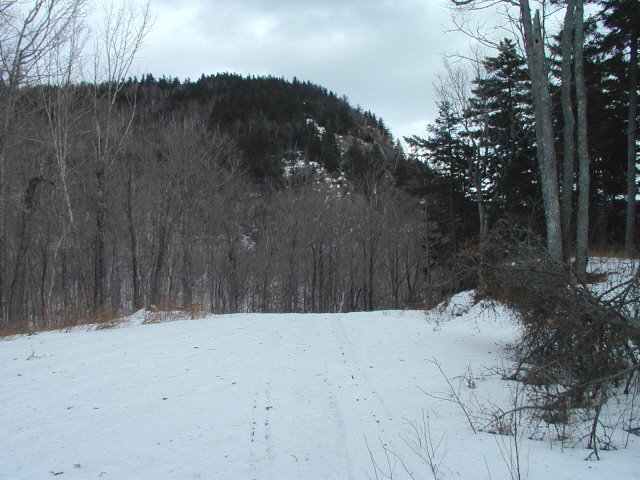
Looking down the cliff face to the west (200') to the lake below:

Monday, February 20, 2006
Say What?
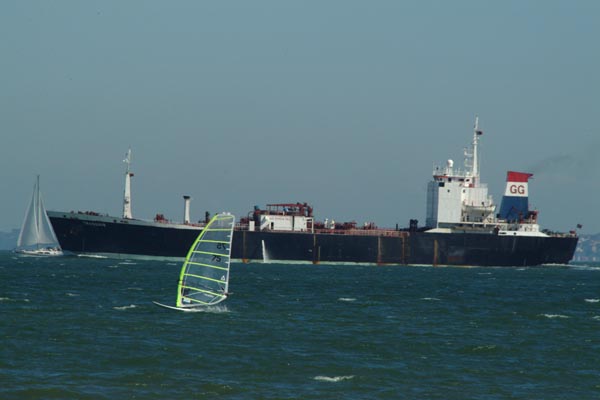
The other day, while checking my boat during a bad southwest storm, I overheard the pilot boat captain talking over the radio to one of the outbound ships. Because of the weather the transfer was being made well inside of the pilot station, not unusual for this type of situation, weather being what it was. However, after the transfer was made, I heard the pilot say to the ship's captain: "Have a safe trip."
Maybe I'm a bit too whimsical but when I heard that I laughed. In my mind, telling a liquid container ship captain to have a safe trip is a lot like telling Merryl Streep to do a good job at her next acting gig. Or telling Jeff Gordon to "Drive fast."
It's a given that people don't always say the right thing at the right time. Even our president has a propensity to flub-a-dub-dub his lines. If the President can get away with it, why can't a pilot boat captain? Or anybody else for that matter?
I'm sure more than a few people have told you, "Drive safe." Or, "Have fun." It's human nature to want to have the last word, no matter how nonsensical, inappropriate, or just plain stupid. But telling a ship captain to have a safe trip, well, that just takes salutatory conversation to a new low.
She could have said: "Have a good trip." Because that might mean . . . don't catch a cold on your way across the pond. Or, I hope you see a couple good movies on your trip, or you receive happy news from home.
I hope a live tuna accidentally jumps onto the ship and you all have sushi grade tuna steaks for dinner one night.
Or maybe just say: "Fair winds, Captain. See you on your return." When I was captain of the pilot boat, I always made it a point to call them, Captain.
Have a safe trip. I still can't get over that.
-seabgb
Thursday, February 02, 2006

Friday, January 27, 2006
A Bad Trip Gone Good

A few days ago I commented about passengers aboard the QM2 who had threatened a sit-in after a casualty in one of the ship's propulsion pods caused the owners to cancel three scheduled stops. The news reminded me of something that happened on my boat several years ago.
Back when I was running trips regularly I took a group of some forty people to see the puffins on Seal Island National Wildlife Refuge (NWR). This was a very common and routine trip for me, but on this particular day of flat seas and calm winds, I had the misfortune of suffering a similar casualty, though on a much smaller scale.
It happened when we got out to the island. In fact, the whole affair was kind of humorous.
On the way out a pin hole in my oil cooler created a vacuum that sucked the oil out of the transmission. Everything was fine while we were steaming along, because it was calm and the pressure plates in the transmission were already jammed together in forward gear. It was only when I slowed and then put the transmission in reverse that the problem became evident. (I have since added a transmission oil pressure gauge to prevent this sort of insidious casualty from recurring.)
The funny part was this: I had asked a friend to come as mate. He's a self-employed boat builder and all around nautical genius whom I thought needed a break and some fun in the sun. Besides, he'd never been out there, and had never seen a puffin. For the two hour trip to the island, he mostly kept me company in the wheelhouse, except for when he went on deck to schmooze with the customers or bathe in the early August sun.
At my destination, I would typically take the boat straight toward the rock ledges at the northwest corner of the island. It's deep there, it's where the nesting sites are, and I can bring the boat twenty feet from the birds. If I wanted or had to, I could lay the bow onto the smooth rock outcrop of the island without damage to either the boat or the outcrop. The geology of the place, and its seasonally protected location, afford me that luxury. In fact, I often played a little prank on the passengers standing on the foredeck by pretending to NOT be paying attention as we closed the distance to shore. Out of the corner of my eye I would see nervous heads on the bow turning around to make sure their captain hadn't had a heart attack or lost his mind. At the very last second, when collision seemed imminent, I would put the boat in reverse and stop all headway. We were never going very fast, and it wasn't like I was taking any risk (as you'll soon discover) but it was still fun.
Unfortunately, this time was a bit different. My nautical genius friend Bernie standing beside me, I headed in. We got closer and closer, heads turned, puffins flew here and there, and Bernie was saying, "Bob? Um, Bob? The island, Bob." I pretended to NOT pay attention, then close enough, collision pending, prank satisfied, I put the gear lever in reverse.
But there was no reverse. The boat continued forward.
Bernie said: "Bob?
And I said: "Huh, guess what Bernie? I have no reverse gear."
Bernie's first reaction was: "That's funny. Stop the boat."
"No, seriously, Bernie. I have no reverse. Go astern and get the engine box cover off and see if it's a linkage or cable problem." At which time Bernie disappeared aft in the blink of an eye.
I turned the helm hard to port and the combination of bare headway and a light easterly wind turned the bow. I felt the hull squeak over the ledge as we slowly turned and then inched toward open water. The passengers, of course, were stupified.
I let the boat drift into deeper water where I set the anchor. Problem identified, I called a friend for a tow. Here's where the story relates to the QM2:
On the way home, being towed in by my friend, I told the passengers there would be no charge for the trip and also that everyone who had already paid would get a full refund. Guess what? They were happy. They didn't want a refund. Passengers who hadn't yet paid tried to force cash into my hand. When I refused to take it, I discovered later they had secreted away the money in the folds of my 55 plus life jackets. For weeks afterwards, I was finding money tucked away on the boat. In the end, I had made my charter fee and more.
Talk about having a renewed faith in humanity.
-seabgb
Thursday, January 26, 2006
Winter's Reflections
 The photo above is from last year. You're looking at approximately three feet of snow, compared to roughly four inches for this season. From January 1 until now, we've had temperatures above freezing. Not that I'm complaining . . . I don't own a snowmobile or a pair of skis.
It's nice to have a break from shoveling, plowing, snow blowing, skidding, slipping, falling, and generally freezing your ass off. Except, as I implied above, when you happen to be a winter sports enthusiast -- or an oceanographer.
Last year was the coldest, snowiest in decades. This year just might be the mildest in decades. I'll let the scientists and politicians argue about whether it's due to global warming or not, although, according to new methods of analyzing glacial core samples in the arctic and antarctic, there's more carbon dioxide in the atmosphere now than there has been in the last 650,000 years. That's a scientific fact. No disputing it. 650,000 years is a seriously long time.
If, in fact, there is a thing called global warming, and if in fact it is caused by runaway industrialization and not Al Gore blowing hot gas into the atmosphere every time he speaks, it is a mixed blessing for future boatmen. As the glaciers melt, the oceans will rise, we'll get more waterfront. We might even get a much longer boating season, for awhile. Unfortunately, on the down side, extreme weather will be more prevalent; we'll see many more hurricanes, stronger ones with winds of 200 mph, devastating droughts, unusual temperature gradients, and the eventual onset of an ice age. The possibility that all the fundamental food groups in the sea will die off (due to the increased influx of UV radiation through the hole in the ozone layer, caused by the increase in ozone eating chlorine from CFCs) doesn't bode well for the sport fish industry. Rest assured we can always use our big, fat, empty ocean as a giant receptacle for our garbage and chemical waste. Oh wait, that's right, we do that already.
Many people like to point out this problem (and everything else) is all the fault of our current President, as if he invented the combustion engine and is single-handedly making sure each and every individual in this country burns as much fossil fuel as possible. I would like to point out that even if we had a President who made it his primary objective to reorient this country's technological future, the world situation would not change appreciably. Over 2.5 billion Chinese and Indian consumers will make sure of it. So will developing nations in the third world that expect the same environmental waivers we took advantage of when words like conservation and environmental protection hadn't yet been added to the American lexicon.
How do you convince the have-nots they can't have the same opportunity for growth?
For example, look at the Montreal Protocols to eliminate CFCs from production. Many nations signed the treaty, but regulations were prorated for developing countries. Hailed by Kofi Anon as one of the U.N.'s crowning achievements, the treaty is not enforceable, nor will it do much to change the health of the Ozone Layer, not when you have countries like India and China playing industrial catch up with nearly ten times the population of the U.S. (By some estimates, the smuggling of CFCs is second only to illegal drugs.)
Don't get me wrong, I'm for it. From an environmental point of view, it's a step in the right direction. Economically, globally, geo-politically, I'm not sure it's such a good idea to lead the way.
You know the Michael Jackson song, "I'm starting with the Man in the Mirror"? Say what you will about Michael (I know I will), but that's a great song.
You can't eat sea bass or swordfish and at the same time complain about the Kyoto Accords.
You can't blame President Bush for being environmentally irresponsible and at the same time own an old refrigerator that uses CFCs as a refrigerant.
You can't complain about the U.S. dependence on foreign oil and drive an SUV and, at the same time, protest against nuclear power.
-seabgb
Monday, January 23, 2006
Mutiny, Dissent and Piracy
 Me and the old man on the Suez Canal, October 1973.
First, regarding the report of a threatened mutiny aboard the Queen Mary II. This is yet another case of the media blowing a story way out of proportion. According to reports, passengers are planning a sit-in because the ship is missing three of its intended ports of call. But, of the 1,000 passengers, how many are really planning a sit-in? Probably a very small percentage. And is a sit-in considered a real mutiny? Maybe by definition, certainly not by naval standards.
I'll further bet the cruise line and the passengers will reach a mutually satisfactory agreement. I'm thinking full refund, which is what I would do if I had veered off course and busted a propeller in the shoal water of a channel.
Hey, they have insurance, right?
But nooooo. The owners want their money even though they are no longer providing the advertised service, and the media has to take the story, and as usual, make it sound as outrageous as possible. The headline from Independent Online touts:
Passengers threaten mutiny on crippled 'Queen Mary 2'
Let's get real. Is the ship actually crippled in a marine sense? Well, yes it is. It had to be towed back to Ft. Lauderdale. But that was more than likely a Coast Guard mandated safety precaution. In fact, the ship lost capability in only one of its four propulsion pods. It still had three fully operational pods. Ships like these are built for every contingency. They have redundant systems galore. Four independent propulsion systems is proof of that.Now, is a passenger sit-in a mutiny? If you ask me, I'd say no. Despite the fact that by definition a mutiny can be a form of passive resistance, in my opinion, on a ship, passengers can't be mutineers without violating the law and/or forcibly rebelling against authority. If you rented an apartment, and decided to stay after your lease was up, you would not be violating the law until it was so determined by legal proceedings and a judge's order.
The headline for the story implies the ship was incapacitated and the passengers were running to and fro with parrots on their shoulders and knives between their teeth.
Why must the media take these events and turn them into stories of catastrophe, mayhem, Armageddon?
The headline should have been written as follows:
Disgruntled QM2 Passengers Threaten Sit-In
Now here's another interesting story: American naval forces chased and captured a pirate ship off the coast of Somalia. It was a large motor driven Arab Dhow with a mixed crew of Somali and Indian men. Apparently, the Somalis captured the Indian crew and their ship and forced them into piracy. At least, that's the crew's story.
Nice little business opening up there, running guns from Somalia to Egypt and then through tunnels into Gaza.
Speaking of terrorism, another worthy news item came to my attention recently.
To all the people who like to claim their anti-government criticisms and dissent don't help the terrorists, I offer the following from Reuters:
Apparently, William Blum's book is so good, it got an Oprah-like endorsement from Osama bin Laden, which boosted book sales on Amazon to bring its rating from somewhere over 200,000 on the list to 30 on the list. Read the story here.
According to the story, Blum wasn't too upset about Osama's endorsement. As long as Blum's making money, I guess.
Just another spin-doctor opportunist willing to jeopardize his fellow-Americans for a buck. Shameful.
-seabgb
Thursday, January 19, 2006
Getting Blown Up at Sea

I received the Munitions at Sea Handbook from the Defense Ammunition Center yesterday. I've been a fishermen for twenty plus years. As far as I can recall, this is the first time I ever got one of these pamphlets. 'Bout time.
A lot of people don't realize that fishermen get blown up at sea as a result of unexploded ordnance. Torpedoes, bombs, mines, etc., get towed up in nets and other fish gear and get hauled back to the boat. By the time a captain and crew realize what they have, it's too late. You think of stuff like this happening in Afghanistan or Vietnam. You don't think of it happening in the U.S.
Where I live, most everyone knows - personally or by way of a friend - someone who has either lost his life or was seriously wounded by a bomb. There are also those who went missing at sea with no apparent explanation. What happened to them? No one will ever know. It's possible they ran afoul of an old mine or torpedo.
The photo on the cover of the pamphlet is pretty frightening. I'm not sure the scan illustrates it clearly, but the pamphlet shows a crewman in short sleeves leaning over the net at the stern of the boat. Inside the net is what looks like a long, cylindrical bomb. I don't know who that crewman is, but if he's around, if his crew mates are around, they can consider themselves very lucky. These munitions are deadlier now than when they were built because the years of dormancy have made them very sensitive and unstable. As the pamphlet states: MUNITIONS ARE DESIGNED TO BE DANGEROUS!
Munitions can look brand new or they can be almost unrecognizable. However, fisherman and other mariners have an intuitive sense of things that come out of the sea. They know when something looks wrong. They also know when something looks right, or valuable, like a sea treasure. A brand new bomb looks wrong, very wrong. An encrusted one . . . that's where it gets confusing -- and tempting. For example, a torpedo or large aerial bomb encrusted with marine growth might look like an old revolutionary war cannon. The temptation might be to get it aboard, hammer off the growth and get a closer look. Fishermen are the quintessential seekers of mysterious fortune. They dream of riches from the sea. To a fishermen, a bomb from the deep can be like the siren call of untold wealth and happiness.
For more info on munitions from the sea contact the U.S. Army's Safety Education Website. Or call (918) 420-8919.
-seabgb
Monday, January 16, 2006
Owning the Night

Fishermen wake up early. Most of my friends who lobster get up at about 0230. Some nights, that's about the time I go to bed. I hear my neighbor slam the door to his truck, hear him pull out the driveway. I hear his sternman arrive, a younger man with a slightly tricked-out ride. Headers, lift, big tires. I hear both trucks leave, then I shut off the computer, go to bed and sleep until 0700.
In years past, on the return leg of a pilot run, I'd pass the herring boats on their way out. They fish through the night. Herring is the night fish.
Pilot boat work knows no schedule. It's 24/7. Worst runs were the ones for which you had to wake up at 0100. On those runs you had to decide whether to just stay up and wait or go to sleep for a couple of hours. On Monday night, with a football game on, the decision was easy.
Nine times out of ten, it was better to get some sleep. You always regretted staying up the minute you slipped the dock lines and got underway. It hit you then, the fatigue.
This morning the dog woke me at 0430. At first I thought the raccoons were back at the bird feeders. I heard thumping sounds. Turns out it was just the cold snapping a few sheet rock screws, or the house shifting on its foundation. That, and the dog really had to take a dump.
Sweat pants, shirt, sweat shirt, wool vest, parka, ski cap, hood, two pairs of socks, boots, gloves.
Winter's a bitch. Especially if you don't appreciate the subtle beauty, the quiet, the distant light of the stars and planets, the moon poking through the clouds, snow and ice crackling under your feet. Your breath freezing and choking you.
If there was one thing that made those off hour pilot runs bearable it was the solitude and the shear beauty of the morning. Being the only ones up, it's like you're the owners of the morning, the sole proprietors. Makes you feel rich.
Too bad it's so damn cold.
-seabgb
Wednesday, January 11, 2006
Right Whale Rights

Just noticed the NMFS has a right whale warning out for the Gulf of Maine. Near as I can tell one right whale has been spotted about 60 miles or so off the coast. It's not exactly in what would be considered a traffic lane, but it is in a place of fairly heavy commercial ship and fish boat traffic.
[Slight correction needed to the above statement. On further review, NOAA/NMFS has reported 40 whales (not one as mentioned above) sighted in an area approximately 70 nm SE of Portland, Maine.]
If you've read this blog or have been keeping tabs here intermittently, you know I am an environmentalist and animal lover and would never in my wildest, most extreme moments advocate anything less than total and complete adherence to the laws and even the spirit of conservation.
On the other hand, the right whale is one pathetic earthly creature, and I wonder if at some point man will just have to slap his giant baleen filled, callosity encrusted whale face and say: "Get your damn shit together!"
I've taken many a passenger on whalewatch trips, and I've seen multitudes of whales and other cetaceans. I have never seen a right whale in the wild, and I'm not exactly sure I would care if I did. In film footage, they appear lackadaisical and boring, sluggish and lazy. That, or they're just pompous asses that expect everyone else to get out of their way.
Is it any wonder more right whales get hit by boats than any other type of whale? Is it any wonder it was the easiest whale to hunt in times of old?
Maybe they're just indecisive. They don't know which way to go. Even their blow is indecisive. It streams out of their blow holes in two directions in the form of a "V."
Yeah, I know, we have to take care of these things. But Jeeze-Louise. They have responsibilities too. They could meet us halfway. They could dive once in a while, get out of the way, show some basic survival skills. I mean, at this rate, they'll be on welfare in a few years. We'll be feeding them at sea, then towing them around to keep them from sinking to the bottom and rotting. I ask you, is there a more melancholy marine mammal? Well, maybe the manatee.
You don't get the name sea cow because of your ability to chase down barracuda.
-seabgb
The Book of Broken Dreams
 On a recent visit to a small boat yard the other day I got to talking to the owner. He's a hands on guy who started out repairing, rebuilding, selling and installing marine engines. That used to be his sole operation but he has since expanded to other forms of marine construction, including retrofitting, boat repair, fiberglassing, etc. He had a couple of boats in the shed, one was a small Duffy that was getting a new deck, the other was a 45' MDI someone local had purchased in Long Island, N.Y. The MDI was being converted from a longliner to a lobster boat.
If I had unlimited funds and could afford a new boat, it just might be that MDI 45. It's a nice, big boat, with pretty lines. It's the kind of boat I might have designed had I the time, money, and motivation.
What happens to guys up here is this: After years of working in a boat business, either as a fisherman, party boat operator, professional captain, whatever, you reach a point where you figure you can do it better than the next guy. Problem is, designing and building a hull is a real experiment in faith. Unless you have a few million dollars to invest in preliminary testing, CAD-CAM, tank tests, etc., you really don't know how your finished product will perform.
There's a well known industry classified paper called Boats and Harbors. It comes out three times a week and it's chock full of broken dreams: Boats that were purchased with the hope of finishing them off; Project boats; Strange hull designs. Don't get me wrong, the paper has all kinds of perfectly good boats for sale. It also has a lot of garbage. A lot of perfectly good boat blunders.
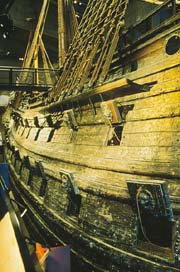
Probably the most famous of all boat dream blunders is the Swedish Flagship, Vasa. On August 10, 1628, with a light breeze blowing from the southwest, she left her berth for her maiden voyage, fired off a farewell salute from her gun deck, maneuvered about a half mile from the quay, raised her sails, and promptly capsized. She had been designed and modeled by the venerable Swedish king, and no one, not even the royal engineer, had challenged his planning. At the time, she stood as the most ornate ship ever built.
The Vasa has since been excavated and preserved. She now sits in her grand archeological glory in a Scandinavian museum as a testament to the folly of intelligent people who should know better than to play with fire, or, I should say, water.
-seabgb
Subscribe to:
Comments (Atom)