I love a launching. Whether the boat’s brand new or just freshly painted, I can’t help noticing how pure and unsullied the thing looks. As Madonna would say, “Like a virgin.”
And yet, lot’s of things can go wrong at a launching. For example, I heard this story about a big, wooden dragger. . . . The builders never put weights on the cradle, so after the boat slid into the water, stuck was the baby, cradle and all. Kind of embarrassing.
There’s also the story about the multi-million dollar sloop that slid off the ways and kept on going. It turned out that the sloop’s transmission failed, and the yard skiff the builders had standing-by to tend the boat didn’t have the power to control it.
And how could I forget one of the most famous launching disasters of all time, that of the poorly designed and extremely top-heavy, Vasa?
On August 10, 1628, the flagship of the King of Sweden left her launch site in Stockholm with all her flags flying. She sailed less than a half mile, ran into a sudden squall, and tipped over. The 1300-ton warship took water through her open gun ports and sank. Very embarrassing, yes, but also fatal. A good number of the King’s best fighting men, as well as a few members of the aristocracy went to their graves amidst the wreckage.
In comparison, my launching experiences are kind of anticlimactic, although they didn’t seem that way at the time. At one yard, my lobsterboat got thumped on the bottom when an overanxious hoist operator lowered it too quickly in too little water. I was a bit miffed but . . . no serious harm done. Another time, at the same yard, while backing out of the slipway, my prop sucked an old canvas dodger off the bottom. It stopped the engine cold and set the boat adrift toward a grout pile.
My favorite was this one guy who told me I had plenty of tide. Famous last words. I came down the ways -- in a 50’ wooden deadrise-style party boat this time -- only to get stuck in the mud. He assured me I had lots of water and could back her out. When I tried, the bow came off the cradle and dropped a foot through open air. Thanks to his great advice, my stopwater leaked all season.
-seabgb
Saturday, April 21, 2007


Wednesday, February 28, 2007
Nisshin Maru Fire Extinguished
The Nisshin Maru, the Japanese whaling ship hunted, haunted and harassed by Greenpeace and other anti-whaling activist organizations, suspended whaling operations due to a fire that occurred earlier in the month. Vessel will go home for repairs about 350 whales short of its harvest goal. Good news for the 350 whales, and good news for whale watch boat operators like myself.
Greenpeace vessel Rainbow Warrior and other anti-whaling vessels have been battling the Nisshin Maru for years. These encounters have included interference engagements and collisions. The Japanese vessel, largest of the whaling fleet, is ostensibly engaged in whale research. If you believe that I've got some Florida swampland to sell you.
Fire aboard the vessel claimed the life of one crewman and damaged much of the whale processing plant. Vessel had lost power for some ten days and took on a port list. There was fear, according to Greenpeace activists, of a serious oil leak and the vessel coming ashore on a known penguin sanctuary. However, neither of these situations materialized
Nisshin Maru was assisted by another Japanese fishing vessel, the Yushin Maru No 2., and taken in tow back to Japan. It is not yet clear if the stricken vessel has regained power or her ability to make way.
-seabgb
Sunday, February 25, 2007
A Sirius Weather Feed

If you’ve been keeping abreast of developments in navigation electronics you know the trend is toward multi-functionality, e.g. using one display for everything from engine data to soundings. Now we have Sirius Radio and WSI joining forces to bring live weather data to your dedicated plotter. Imagine that. A live weather satellite feed directly to your plotter. Sounds great, doesn’t it? Unless, of course, you have doubts about getting your data from the same people who bring you Howard Stern.
But wait. This isn’t just Sirius Radio at work here. It’s also WSI Corporation, the world’s largest commercial weather database, and The Weather Channel Marine Service.
These three companies are hoping to attract you with their special brand of value-added product. In other words, they collect the data, reconstitute it, and feed it back you in a way that makes it easier to digest. They’re banking on you being a niche consumer. Not too big you already have full download AND upload satellite capability. (Remember, the Sirius/WSI feed is download only.) Not too small you’re satisfied with the morning forecast and/or buoy report. They’re also figuring you prefer a sit-down dinner to a buffet, and that, either way, you don’t like to spend a lot of time chewing.
Truth is, you can get all this stuff yourself. You can go to any number of government and/or University Websites and surf the data and images online. You can even download free imaging software and personalize your weather and radar maps. This is why I mention buffet-style versus sit-down above, because if you do it this way, you’re going to be chewing on a great many more choices.
Furuno, Raytheon, and Northstar, are all on board with the new Sirius satellite feed. Furuno trails the others by a few months but says it will have a product available this spring.
So, is it worth the money? Costs will range anywhere from $29.00 a month (basic) to $99.00 a month (pro). And, of course, you have to buy a Sirius antenna and receiver.
My guess is day boat owners will say no, unless they’re gadget geeks or the type who need all the bells and whistles. Fishermen and yachtsmen who want full Internet capability will opt for broadband satellite (e.g. Sea-Tel) or cellular service (e.g. Sigma6) the latter limited to a range offshore of only 30 or so miles. Who does that leave?
Maybe just Howard Stern fans.
Monday, February 12, 2007

Wednesday, February 07, 2007
Tom's Meg Teeth

Swimming with Megaladons
by Tom Simmons
by Tom Simmons
It all comes down to this: teeth or no teeth.
Three days of perfect diving off the coast of North Carolina. Out in the Gulf Stream where the water temperature at 120 feet is 82° F. Visibility 80 to 100 feet. Open sea as flat as a lake so the 40-mile trip out to the sites is a walk in the park. Even the locals are in shock. Life just doesn't get this good very often.
My son (15) and I have just completed our first deep water, Nitrox dives. We've been on a U-Boat and WWII freighter. We've been to a wreck that's a Sand Tiger Shark breeding ground. This morning, we went on a dive that finally identified a wreck sunk in the 1920s by measuring her length, beam and boilers. This is what you dream about. And it all means nothing, nothing without teeth.
It's the afternoon of our third day. Our sixth dive. We're anchored over Fossil Ledge where we hope to find prehistoric shark teeth. Megaladon teeth. Teeth as big as your hand. My son has thought of nothing else during the three months since we planned this trip. If we find teeth, we've had the trip of a lifetime. If we don't find teeth, it's all been for nothing. Wouldn't matter if we rode the Loch Ness Monster.
No teeth, no fun. That's the rigid calculus of this trip.
Andre, the dive master who set the anchor, has come up with a goody bag filled with teeth. Fourteen of them. One of the passengers is a little frosty to think that there are now 14 fewer teeth on the bottom for others to find. But the rest of us are just hot to get down there and hunt. It's all about teeth.
"Don't move around," Andre instructs. "Stay in one place. Keep digging in one place." You're telling my 15-year-old not to move around. It's like telling the wind not to blow. He's not going to spend 20 minutes of bottom time digging a dry hole. Two minutes, max.
We follow the anchor line down. At 60 feet a huge ball of bait fish, so thick it looks like the bottom, swims below us. In its midst, moving lazily with the school, is a 12-foot Sand Tiger Shark. What a fabulous sight! Incredible. Meaningless. Nada, zilch, bupgus, zero. Nothing if we don't find teeth.
The bottom at the anchor is sandy with rock outcroppings. Andre said to dig near the rocks. I hung on every word, gathering them in my memory like golden secrets of life. We tie our wreck reel to the anchor line and move 20 feet away, toward a likely looking outcropping. (They require wreck reels on Fossil Ledge, an advanced dive, because on every single trip this summer someone with Teeth Fever has lost sight of the anchor line and bobbed up to the surface down current from the boat. Every. Single. Trip.)
We start digging in our likely spot and the water around us becomes silty in seconds. Every minute or so, I stop digging and let the current take the silt away. Nothing. There are petrified whale bones by the hundreds. But we don't care about them. We're after teeth.
About three minutes in, my son is on his second spot. Nothing. I let the silt clear and see a large black fish, immobile, about five feet away from me. He has silt on his head. And he's looking at me like Eyore. "You gonna be long? 'Cause I'm getting a little dusty here."
Another minute and let the current clear the silt. What's that? Damn! There's a Megaladon tooth in my hole. Huge. Gorgeous. I grab it as if it might swim away. Good size. Good enamel. I tap my son on the shoulder and hand it to him. It goes in his goody bag. And he digs faster, like a person possessed.
Now he's off to another place. Chasing fish is always fun. I keep digging. About five minutes later, I've got another tooth. Now, I'm as excited as the next guy and I enjoy the discovery. But more than anything, these finds have ratified the whole trip. I now know we've had a good time. I know it wasn't all for nothing. Life is good.
In a few minutes, we're headed up the anchor line. On board, everyone compares finds. Some found more. No one found better teeth than ours. The grumpy guy got none and he's convinced it's because Andre took fourteen of them out of the running. He's pissed.
"Nice teeth," Andre tells my son. My mood can only be described as serene. We found teeth. All of the other fun things we did on this trip get to stay fun. It is a dream come true. And better. We got the teeth.
Teeth=Fun. It's great
Written by Tom Simmons
Photo by Tom Simmons
Thursday, February 01, 2007
Boarding Last November

Heading out for a sea trial after some minor engine work. Joined by friends, Dwight, Larkin, Hugh (on camera) and Hugh's dog, Dave. . .

Seas in the 4' to 8' range. Winds from the northwest.
 What's that astern? Small orange boat going 30 knots or more. Blue light.
 They had been trying to board the new boat for quite awhile. New boat in town. An unknown. They attempted a week earlier in the 47' MLB but decided to postpone the boarding as I was in the middle of a survey.
 It always pays to be courteous and cooperative during a boarding. Prickly and confrontational gets you nowhere.
My thanks to Hugh R. McKellar for the photos.
-seabgb
Saturday, January 27, 2007
Fire Suppression Systems

erosfaust
If necessity is the mother of invention, one of its grandkids is bound to be a screw-up. Case in point:
Non-automated fire suppression systems went into use in textile mills in New England as early as 1852. Twenty years later, an engineer from Massachusetts came up with an automated system, and two years after that someone else, a guy named Henry S. Parmalee, made a sprinkler head that really worked. In 1874, Parmalee installed what was probably the first functioning fire suppression system into his piano factory. These, of course, were all mechanically operated sprinkler systems.
While we still have automated systems that work purely by mechanical means, using principles of pneumatic or hydraulic expansion, many, if not most of today’s systems, particularly those on boats and ships, rely on an electrical circuit for fire detection. Herein lies a serious problem, because without early warning capability, the vessel’s crew and passengers are at the mercy of lady luck.
In October of 2004, a fire destroyed the Express Shuttle II, a 65’ passenger vessel operating out of Port Richey, Florida. Following an investigation of the incident, U.S. Coast Guard officials decided to take a long, hard look at custom-engineered fire fighting systems. Systems using DC electric detection components were most suspect.
What happened aboard the Express Shuttle was not atypical of many engine room fires. A high-pressure fuel leak in one of the boat’s two Caterpillar engines sprayed fuel on the engine’s hot manifold, causing the fuel to ignite. Instead of manually triggering the fire suppression system, the crew (a captain and two deck hands were aboard as passengers had just previously disembarked) decided to fight the fire with hand held extinguishers. The fire rapidly became unmanageable and the crew had to abandon ship. Vessel was a total loss.
Coast Guard Investigators determined the loss was due to three factors: poor maintenance of the fuel feed line to the number five cylinder; inadequate crew response to the emergency; a non-functioning fire detection system; in fact, the fire and smoke alarms on the vessel never sounded.
For further reading, try the full NTSB Accident Report on the Web: http://www.ntsb.gov/Publictn/2006/MAR0602.pdf. And note the following U.S.C.G. recommendations:
1) A panel light should notify an operator of a fault or break in the fire detection circuit.
2) Detectors should be UL, FM or LPBC approved.
3) The system should be testable by smoke or heat.
-seabgb
Wednesday, November 29, 2006
Don't Forget to Update Your Charts!
Sorry I haven't been very attentive to the blog of late. Pressing problems at home. Work on the the boat. Yada-yada. I know. Who cares? But here I am -- with some info on mapping software for you to stew on.
I use Maptech's Offshore Lite, a great package that comes bundled free with their Chartbook. Basically, it's an abbreviated version of their professional navigation software. You get digital versions of all the charts in the Chartbook but not all the features of the Nav software. For example, while you can track vessel's position with an integrated GPS, you don't get the full save and store capabilities of Offshore Pro. You don't have access to bathyspheric and other data, like tide info. You can't place a mark or waypoint on your vessel's position at the touch of a button, nor can you tie into an autopilot, or transfer routes and waypoints to and from your GPS. As I said, it's a great little tracking and plotting program that does the job and more. However, the more you use it, the more you will want to buy the pro version. And if you're doing any kind of commercial work, whether it's fishing, towing, whatever, you'll need Pro.
I'm currently doing an underwater survey using a magnetometer and forward-looking fathometer. I collect event data using proprietary logging software, and I create event markers on a C-Map cartridge being displayed on a Hondex plotter. I also take the raw data output from the Mag and manually transpose it to the Maptech charts in the form of event markers. In other words, I use the Hondex to re-locate targets, and the Maptech chart -- a NOAA chart with real NOAA symbols -- to chart my data. It's not an ideal situation because even though I have the redundancy aspect working in my favor, I'm doing a lot of extra work. Why not just keep a running plot of event markers using the Maptech software? The answer: Because Maptech Lite can't do it. You need the Pro version. I tell you this to give you an idea of the advantages and disadvantages of both.
The big advantage of Maptech Lite is that you get real-time tracking capability on a NOAA chart for free, or what amounts to 'free' when you buy a Chartbook? You still need paper charts to be legal, so why not get the Chartbook and play with Offshore Lite. It's free?
-seabgb
Sunday, October 29, 2006
Saturday's Storm
Those who prepared for it:

And those who didn't:

Results of 63 Knots at the Rock. 15' to 20' seas.

And those who didn't:
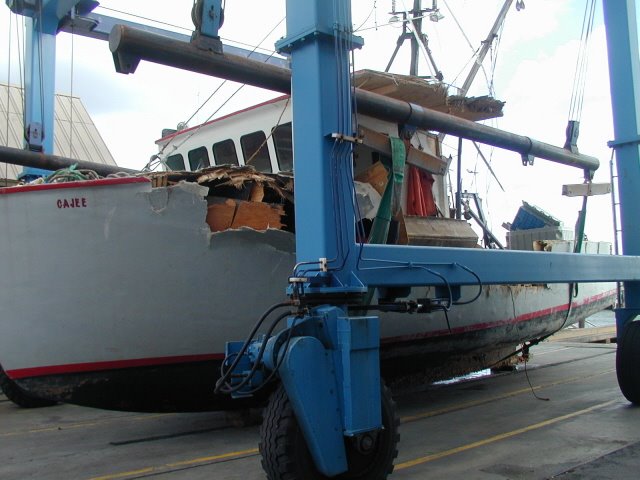
Results of 63 Knots at the Rock. 15' to 20' seas.
Wednesday, October 11, 2006


Tuesday, October 10, 2006
How to Re-Document Your Own Vessel
Here's how you can save a little money by doing the Purchase and Sale Agreement and the re-documentation yourself . . . assuming you have no broker, bank, or other mortgage interest involved.
First, get the Name and/or Official number of the vessel and get the Official Document info on line. Next, take this info and use it to fill in the blanks in a standard Yacht Purchase Agreement. You can find one of these online by doing a Google search for "Yacht Purchase Agreement." Pick one that comes in a PDF Format so you can fill in the blanks on your computer. Include names of purchaser(s) and seller(s), addresses, purchase price, boat name and official number, description of vessel, and attach a list of the equipment that comes with the boat, right down to galley utensils if there are any. No SS#s are needed here. Also list the contingencies of the sale, i.e. survey, financing, sea trial, etc.
Remember, with these online PDF files you can't save the document, so print out as many copies as you want. There should be one for you and the seller, and one for each and every buyer and/or seller, in the event there are multiple buyers and sellers. Each copy should be signed and dated by both parties, and each one notarized. Again, make sure you have all the agreed on conditions of sale, e.g. survey, loan, sea trial, things to be fixed, etc.
Now go to the USCG National Vessel Documentation Home Page and download the appropriate forms, first and foremost of which is the request form that will tell you what if any liens there are on the boat. This is the Abstract of Title request. Send this in first. You should have results in a few days. If there are any outstanding liens (preferred mortgages on the boat, these will have to be satisfied or released before a new document can be issued. Applications for Satisfaction of Mortgage, and forms for filing of mortgages, are also available on line at the link above.
For re-documentation, you need a notarized Bill of Sale, a Satisfaction/Release of Mortgage statement for each mortgage (signed and notarized by a bank official), an application for Filing of Mortgage (if in fact you're financing with a mortgage company or assuming someone else's mortgage), and the current Certificate of Documentation signed over to you.
All these blank forms are available at the NVDC Site listed above.
One final note: The procedure for documenting a new vessel is slightly different. You have to prove ownership and citizenship, which means you will need a builder's certificate and Form 1258, where you can provide your social security or tax I.D. number.
-seabgb
Sunday, October 01, 2006
After the Purchase....
Every day Moonfish gets a little closer to being ready for sea. I've re-run and rerouted wire, moved electronics, bolted the electronics console in place, replaced worn hose, checked and replaced hydraulic lines, added chafing gear where needed, clamped and wire-tied loose hose and wire, removed wire that went nowhere, tightened the engine belt, built a platform at the helm, checked and replaced engine zincs, replaced rudder zincs, waterproofed some of the windows and hatches, fixed broken fittings, tightened loose screws and bolts, and generally attended to things the previous owner would have done himself had he kept the boat.
For the record, it costs $121.00 to do your own paperwork. This includes an Abstract of Title and the application for redocumentation. A service would charge $300 to $400. I had the paper work done in about a half hour, although I ended up making an unscheduled trip to a bank in order to track down a second satisfaction of mortgage I didn't know about. Took about an hour an a half of my time. Start to finish, I had the the new document in my hand in a week. The guys at the Documentation Center in Virginia work pretty fast.
I needed a marine surveyor for the insurance company. I've had some bad experiences in the past with surveyors, but this guy was OK. In fact, I knew him years ago when he was with the USCG Marine Safety Office. He was one of the inspectors who would visit Finback twice annually for her hull and safety inspection.
Surveyor was Mike Whitten, of Bucksport, Maine. Take my word for it. If you must have the boat surveyed, for either an insurance company or a bank, make sure the person doing the survey knows what the hell they're doing. At $15 a foot, you want to feel like you're getting something more than just a chance to shell out a fortune in insurance premiums. I can't say the money I spent on the survey would not have been better spent on a new EPIRB, which I have to buy anyway, but at least I had a chance to review the boat's systems and condition with someone I respected. Would I have voluntarily chosen to have to boat surveyed had it not been required by the insurance agent? Not on your life.
The only thing left for me to do to be completely legal is to have the new name put on. Both bows and stern. This is kind of a conundrum because I have some gelcoat work to do on the transom, right under where the lettering will go. It's a Catch-22. I need the lettering and name so I can be official and legal and get to work, but if I put the lettering on before I fix the gelcoat, I'll just have to re-do the name afterwards. Oh, well, not much I can do about it.
-seabgb
Subscribe to:
Posts (Atom)