Thursday, January 19, 2006

Getting Blown Up at Sea


I received the Munitions at Sea Handbook from the Defense Ammunition Center yesterday. I've been a fishermen for twenty plus years. As far as I can recall, this is the first time I ever got one of these pamphlets. 'Bout time.

A lot of people don't realize that fishermen get blown up at sea as a result of unexploded ordnance. Torpedoes, bombs, mines, etc., get towed up in nets and other fish gear and get hauled back to the boat. By the time a captain and crew realize what they have, it's too late. You think of stuff like this happening in Afghanistan or Vietnam. You don't think of it happening in the U.S.

Where I live, most everyone knows - personally or by way of a friend - someone who has either lost his life or was seriously wounded by a bomb. There are also those who went missing at sea with no apparent explanation. What happened to them? No one will ever know. It's possible they ran afoul of an old mine or torpedo.

The photo on the cover of the pamphlet is pretty frightening. I'm not sure the scan illustrates it clearly, but the pamphlet shows a crewman in short sleeves leaning over the net at the stern of the boat. Inside the net is what looks like a long, cylindrical bomb. I don't know who that crewman is, but if he's around, if his crew mates are around, they can consider themselves very lucky. These munitions are deadlier now than when they were built because the years of dormancy have made them very sensitive and unstable. As the pamphlet states: MUNITIONS ARE DESIGNED TO BE DANGEROUS!

Munitions can look brand new or they can be almost unrecognizable. However, fisherman and other mariners have an intuitive sense of things that come out of the sea. They know when something looks wrong. They also know when something looks right, or valuable, like a sea treasure. A brand new bomb looks wrong, very wrong. An encrusted one . . . that's where it gets confusing -- and tempting. For example, a torpedo or large aerial bomb encrusted with marine growth might look like an old revolutionary war cannon. The temptation might be to get it aboard, hammer off the growth and get a closer look. Fishermen are the quintessential seekers of mysterious fortune. They dream of riches from the sea. To a fishermen, a bomb from the deep can be like the siren call of untold wealth and happiness.

For more info on munitions from the sea contact the U.S. Army's Safety Education Website. Or call (918) 420-8919.

-seabgb

Monday, January 16, 2006

Owning the Night


Fishermen wake up early. Most of my friends who lobster get up at about 0230. Some nights, that's about the time I go to bed. I hear my neighbor slam the door to his truck, hear him pull out the driveway. I hear his sternman arrive, a younger man with a slightly tricked-out ride. Headers, lift, big tires. I hear both trucks leave, then I shut off the computer, go to bed and sleep until 0700.

In years past, on the return leg of a pilot run, I'd pass the herring boats on their way out. They fish through the night. Herring is the night fish.

Pilot boat work knows no schedule. It's 24/7. Worst runs were the ones for which you had to wake up at 0100. On those runs you had to decide whether to just stay up and wait or go to sleep for a couple of hours. On Monday night, with a football game on, the decision was easy.

Nine times out of ten, it was better to get some sleep. You always regretted staying up the minute you slipped the dock lines and got underway. It hit you then, the fatigue.

This morning the dog woke me at 0430. At first I thought the raccoons were back at the bird feeders. I heard thumping sounds. Turns out it was just the cold snapping a few sheet rock screws, or the house shifting on its foundation. That, and the dog really had to take a dump.

Sweat pants, shirt, sweat shirt, wool vest, parka, ski cap, hood, two pairs of socks, boots, gloves.

Winter's a bitch. Especially if you don't appreciate the subtle beauty, the quiet, the distant light of the stars and planets, the moon poking through the clouds, snow and ice crackling under your feet. Your breath freezing and choking you.

If there was one thing that made those off hour pilot runs bearable it was the solitude and the shear beauty of the morning. Being the only ones up, it's like you're the owners of the morning, the sole proprietors. Makes you feel rich.

Too bad it's so damn cold.

-seabgb

Wednesday, January 11, 2006

Right Whale Rights


Just noticed the NMFS has a right whale warning out for the Gulf of Maine. Near as I can tell one right whale has been spotted about 60 miles or so off the coast. It's not exactly in what would be considered a traffic lane, but it is in a place of fairly heavy commercial ship and fish boat traffic.

[Slight correction needed to the above statement. On further review, NOAA/NMFS has reported 40 whales (not one as mentioned above) sighted in an area approximately 70 nm SE of Portland, Maine.]

If you've read this blog or have been keeping tabs here intermittently, you know I am an environmentalist and animal lover and would never in my wildest, most extreme moments advocate anything less than total and complete adherence to the laws and even the spirit of conservation.

On the other hand, the right whale is one pathetic earthly creature, and I wonder if at some point man will just have to slap his giant baleen filled, callosity encrusted whale face and say: "Get your damn shit together!"

I've taken many a passenger on whalewatch trips, and I've seen multitudes of whales and other cetaceans. I have never seen a right whale in the wild, and I'm not exactly sure I would care if I did. In film footage, they appear lackadaisical and boring, sluggish and lazy. That, or they're just pompous asses that expect everyone else to get out of their way.

Is it any wonder more right whales get hit by boats than any other type of whale? Is it any wonder it was the easiest whale to hunt in times of old?

Maybe they're just indecisive. They don't know which way to go. Even their blow is indecisive. It streams out of their blow holes in two directions in the form of a "V."

Yeah, I know, we have to take care of these things. But Jeeze-Louise. They have responsibilities too. They could meet us halfway. They could dive once in a while, get out of the way, show some basic survival skills. I mean, at this rate, they'll be on welfare in a few years. We'll be feeding them at sea, then towing them around to keep them from sinking to the bottom and rotting. I ask you, is there a more melancholy marine mammal? Well, maybe the manatee.

You don't get the name sea cow because of your ability to chase down barracuda.

-seabgb

The Book of Broken Dreams

On a recent visit to a small boat yard the other day I got to talking to the owner. He's a hands on guy who started out repairing, rebuilding, selling and installing marine engines. That used to be his sole operation but he has since expanded to other forms of marine construction, including retrofitting, boat repair, fiberglassing, etc. He had a couple of boats in the shed, one was a small Duffy that was getting a new deck, the other was a 45' MDI someone local had purchased in Long Island, N.Y. The MDI was being converted from a longliner to a lobster boat.

If I had unlimited funds and could afford a new boat, it just might be that MDI 45. It's a nice, big boat, with pretty lines. It's the kind of boat I might have designed had I the time, money, and motivation.

What happens to guys up here is this: After years of working in a boat business, either as a fisherman, party boat operator, professional captain, whatever, you reach a point where you figure you can do it better than the next guy. Problem is, designing and building a hull is a real experiment in faith. Unless you have a few million dollars to invest in preliminary testing, CAD-CAM, tank tests, etc., you really don't know how your finished product will perform.

There's a well known industry classified paper called Boats and Harbors. It comes out three times a week and it's chock full of broken dreams: Boats that were purchased with the hope of finishing them off; Project boats; Strange hull designs. Don't get me wrong, the paper has all kinds of perfectly good boats for sale. It also has a lot of garbage. A lot of perfectly good boat blunders.

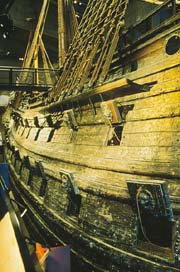
Probably the most famous of all boat dream blunders is the Swedish Flagship, Vasa. On August 10, 1628, with a light breeze blowing from the southwest, she left her berth for her maiden voyage, fired off a farewell salute from her gun deck, maneuvered about a half mile from the quay, raised her sails, and promptly capsized. She had been designed and modeled by the venerable Swedish king, and no one, not even the royal engineer, had challenged his planning. At the time, she stood as the most ornate ship ever built.

The Vasa has since been excavated and preserved. She now sits in her grand archeological glory in a Scandinavian museum as a testament to the folly of intelligent people who should know better than to play with fire, or, I should say, water.

-seabgb

Monday, January 02, 2006

Mutiny on the New Year


Checked the boat on Saturday, then made a morning out of going to the dump. Took the whole family, including the dog. As we drove through the gates of the transfer station, my Mom said: "Oh, I remember this place. You took me to eat here once."

The dump. Ouch. Good thing I didn't have a DHS case worker in the car with me. I'd be in jail now.

Later that night we had a really nice New Year's Eve dinner at a French-style bistro in Camden. After that we went to a party where the conversation eventually ended up on the subject of New Year's resolutions. I mentioned I'd seen William Safire on the news and he was talking about trying to be more of an optimist. I decided to go one step further and I promised to keep clear of cynics and doomsayers. To that end, I plan on reading more William Safire and George Will and less Maureen Dowd and Robert Novak. In fact, The Free Press, if ever in my house again, will be used exclusively to light the wood stove. (Check out the economic, monetary, and global policy theories of Nobel Laureate, Milton Friedman, if you want to be more of an optimist in 2006.)

I'm surprised more people aren't sick to death of the professional cynics, whiners, naysayers and pessimists. They wouldn't last very long at sea.

One time, on a particularly rough outing, I had a lady screaming about how we were all gonna die. I had to tell her to shut up and sit down or I would be forced to sedate her. (I really didn't have any sedatives other than a few Dramamine and a billfish billy.)

I've seen it happen more than a few times. Someone hits the panic button and scares all the passengers. They get freaked seeing someone lose it, especially when their captain is running around with a box of Dramamine in one hand and a billfish billy in the other.

Seriously, panic from a passenger doesn't do the captain and crew any good either. They have their own jobs to do. They're busy. They don't need distractions. In fact, most of us in the passenger carrying trade view panic -- or any other form of extreme negativism -- as a kind of stampeding virus. The more it spreads and gets away from you, the harder it is to stop.

Insubordination doesn't help much either.

On a boat, if you can't make the situation better, you try not to make it worse. Constructive advice is OK. Asking questions is OK. Negativism is not. You don't challenge the captain's authority or question his or her decisions, unless, of course, the captain really doesn't have a clue. But that's the tricky part, isn't it? How do you know? How do you know when the time has arrived for you to become a human monkey wrench? It can't be because you disagree with the course of action the captain has chosen. It can't be because you think it's too rough or too dangerous to continue.

Here's are some suggestions. Not suggestions for when to panic. There's never a good time to panic. These are suggestions for when to challenge the person in charge.

1. He or she has lost the ability to make a decision.
2. He or she has a history of decisions that have resulted in unequivocal disaster.
3. He or she can no longer maintain their leadership by legal, moral, and/or ethical means.
4. He or she has engaged in or promoted illegal or unethical activities.

Not respecting the person, disagreeing with their methods of leadership, not liking their style or personality, doubting their knowledge or ability to lead, questioning their motives, are not viable reasons for challenging their authority.

The Caine Mutiny. Crimson Tide. Two great movies dealing with insubordination and mutiny.

In the first, Queeg, an idiosyncratic and uncharismatic captain, is systematically destroyed by negativism, panic, insubordination, and, eventually, a mutiny. He never really does anything wrong, except that he fails to stand up to his insubordinate executive staff. (The subliminal message here is that any and every person of authority can be broken given the right set of circumstances.)

In Crimson Tide, the captain of the sub, played by Gene Hackman, is entirely in the right by Navy standards. But under increasing pressure, vis a vis a relentless challenge of authority posed by his first officer, his character slips into the third leadership condition given above. He lowers himself to using racial insults and other unethical psychological methods of regaining control of his first officer. (The message here is that under the right set of circumstances, even the strongest leader can make a decision that has dire consequences.)

Although Crimson Tide is packed with tense drama and fine acting, the premise of a recalled launch sequence, in this case the rationale for Denzle Washington's character's actions, is a complete Hollywood fabrication. Nothing like that could ever happen. It's either, get the order to launch and launch, or . . . there isn't an order to launch. Again, there is no such thing as a recall. It's a plot devise created so that by the end of the movie we will view the mutineer, Denzle Washington's character, Lt. Commander Ron Hunter, as the hero.

In fact, in the two movies listed above, the mutineers are wrong. Dead wrong.

Which brings to mind the current spate of extreme negativism being purported in this country by growing numbers of television and political personalities. Some, obviously, have their own self-serving agenda. Others have different motivations, altruistic, ideological, etc. Whatever the reason, I almost wish it were possible to drop them off at the next port of call.

-seabgb

Copyright © Bob Bernstein (seabgb) 2006. All Rights Reserved.

Wednesday, December 28, 2005

My Dad

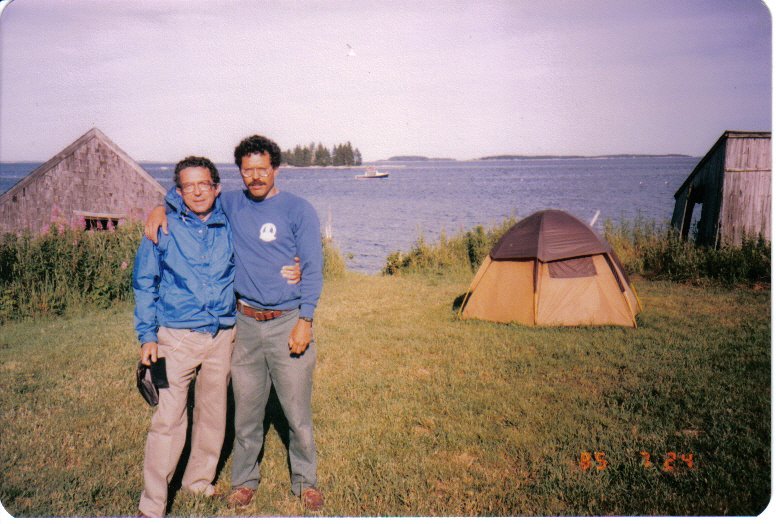
Me and My Dad in South Thomaston, My Old Boat in the Background, Eben Island and the Muscle Ridge Islands in the Distance

It was my Dad who got me into boats, starting with a few fishing trips to Lake Arrowhead in Southern California. It was there, on the shores of a peaceful mountain lake in the middle of San Bernadino National Forest, he dropped an anchor on my foot. I was only five or six years old. My pinky toe still cranes off at an angle from that experience.

Later, a little older, my dad took my brother and me fishing on the reservoirs and rivers in upstate New York. We fished with salmon eggs and all sorts of other baits now banned from the sport. He was patient and caring, reaching for the little jar of brine, taking out a salmon egg as if it were a magic bean, placing it carefully on a tiny gold colored hook at the end of my line. If I think about it hard enough, I can smell his tackle box. I can hear the quiet rumble of the old 5-1/2 hp Evinrude he had, smell its sweet blue-white exhaust.

He taught me how to cast, how to troll, how to tie a knot. In my tackle box, I carry the last of his old bass lures and even some of his spinners. I never really use them. But they're with me. Sometimes, when I go fishing on a lake, which isn't too often these days, I take one of the old lures and fasten it to the end of my line. While my fishing buddy, John, motors us from one spot to another, I stare at the old lure and think about my Dad, how he used to sit in the stern, one hand on the tiller of the Evinrude, the other holding his fishing rod. I remember how he used to stare at the rod tip and hold a bight of the line with his forefinger, ever so gentle.

Thinking back on it now, with his soft touch, I believe he could feel a fish wink.

The picture was taken back in 1983. I had left a high paying job in professional fundraising to become a dive charter operator on the coast of Maine. I'm not sure my Dad ever really understood what I was doing. Although he respected and admired me, and was incredibly proud of me, and loved me, he never said what he really felt . . . that he wanted me to be someone else, for my sake.

Few kids really get that, the feeling their father or mother truly respects them or admires them. I had that. It's a rare thing. My Dad, I believe, felt the same way about my brother, now a surgical radiologist. How lucky were we to have a Dad who admired us for doing things he felt he could not do himself?

And yet, I always knew he wanted me to be someone else. He never really accepted my leaving the city and that job.

My dad died in 1997. I wish I had told him how much I admired him, how much I respected him. How proud of him I was. I never found the time, or made the effort. Although, I believe he knew how much I loved him.

During the last two hours of his life, I vigorously massaged his entire body. He was unable to speak at the time, dying of cancer, on morphine, but he touched my forearms and gazed into my eyes while I rubbed him down. I kept going like that as long as I could, praying my effort would drain him of life, ease his pain. I massaged him so he could die.

The end came about a half hour after I collapsed on the bed next to his. The hospice nurse woke me, said it was time, that he was taking his last few breaths. I got my brother and my mother; we gathered by his bedside.

The actual dying part was a mechanical thing. My Dad, the part we loved, was gone before his body took its last breath.

There were no epiphanies. No revelations. Those would come later, in dribs and drabs. A conversation. A note from a friend of the family. An old photograph. An old letter.

It would be trite and an insult to his memory to say I hope he's fishing some quiet pond somewhere in the afterlife, pursuing the ever elusive quarry of his dreams. It's an insult because he was much bigger than that. He was bigger than the things he loved to do. . . . His was a selfless life . . . spent more for the benefit of others.

He never got the boat he always wanted, a 28' Betram. He never got the cabin on the lake he always wanted, in New England. He never got to see his oldest son achieve the greatness he envisioned for him.

But on his last night, during the final two hours of his life, I believe he realized everything would be just fine, if not exactly the way he had wanted it. He left this Earth as he lived his life, thinking of others. In fact, I believe the only thing he ever did just for himself was allow himself to die.

-seabgb

Holiday Spirit


The wharves around here get quiet around Christmas time. People go on vacation or take time off with their families. Urchin harvesters, lobstermen, yard workers, marine mechanics, they all pretty much stop what they're doing for a few days. It's like that everywhere, I guess.

I went up to Augusta to do my Christmas shopping, took my mother with me. We stopped at Morse's Kraut House off Route 220 for some German delicacies. I bought chocolate rum balls, barbecue sauce, and some canned salmon. My mother met a retired trucker who gave her a hug and a kiss. I wanted to buy more but after checking the gleam in the guy's eyes I hustled my mother into the car and continued on up to Augusta. Sheesh, and I thought my mother was outgoing.

My mother's at the stage in her Alzheimer's where she has to stop and talk to everyone she meets. This can be time consuming, at time downright exasperating. I'm like most men. We don't like to shop. We particularly don't like to shop with our mothers. If and/or when we do go shopping, we do so with the efficiency and planning of a space shot. We don't hob nob. We don't waste motion. It's get in and get out. Like a well planned military strike.

My mother doesn't know from military strikes. Nor does she follow acceptable shopping guidelines for men.

I bought almost nothing. She, on the other hand, bought $176.00 worth of beauty aids, which, incidentally, I paid for.

On the bright side, she promptly forgot what she picked out, so I wrapped them the following day and gave them to her for Christmas/Hanukkah. (Yeah, that's right, we celebrate both. Wanna make something of it?)

Meanwhile, Sandra and I had signed an agreement whereby we would not spend more than $50.00 on each other. I broke the deal by buying a nightgown and robe made in India. The combo cost me $155.00 even though it was probably sewn out of 20 cents worth of material by a fourteen year old kid earning $1.20 a month.

***Warning! Non sequitur Coming!***

Speaking of India, and products made overseas, etc., etc. You hear a lot of rubbish that we're selling off the U.S. to foreign interests and losing economic security and countless jobs in the process. Well, to all the economic fatalists out there, let me point out the following:

Turns out the revenue earned from foreign owned U.S. companies is roughly the same as the revenue earned from U.S. owned foreign companies. In addition, what anti-globalists and anti-foreign policy wonks use as an argument -- that the value or equity of the U.S. owned foreign companies is much less than the value or equity of foreign owned U.S. companies, i.e. foreigners own much more of the U.S. than the U.S. owns of businesses in foreign lands. -- is a misdirection of the truth.

What would you rather have? Would you want to make a million dollars a year from a company that cost you 3 million dollars to purchase? Or would you want to make a million dollars a year from a company that only cost $100,000? Kind of a no brainer.

Speaking for myself, as a small time passenger boat owner/operator, I can say with absolute authority that a more expensive boat costs more to own, operate and insure . . . and yet it does not necessarily provide greater equity. Moreover, you can make as much money from a smaller, less expensive boat as you can make from a larger, more expensive one. It all depends on the market and how good you are at making money.

Remember the adage, Buy Low - Sell High.

Good advice for the country. Good advice for fishermen. Good advice for the holidays.

-seabgb

Atmospheric Conditions and Your Radio


When I was the pilot boat captain for the Penobscot Bay and River Pilots Association there were many occasions when I had to get underway during the pre-dawn hours in order to meet a ship. Invariably, during those early morning runs, a very strange thing would happen. Right around sunrise, VHF radio communications between the ship and pilot boat would become difficult if not impossible to complete. Turns out something happens in the atmosphere at or before sunrise that interferes with a radio transmission. (For more on this subject click here.)

Not too long ago, while in the process of moving my boat from up river to Rockland Harbor, I came across a friend's son who was out to haul his gear. We stopped to talk, then drifted apart and took our conversation to the VHF. Even though he was only a couple of hundred yards away, I could barely hear him. I suggested he get his radio checked, and then another fisherman, probably more than six miles away, interrupted our conversation to say he could hear us both just fine. I couldn't figure that one out until I got home, then it hit me.

My friend's son's radio antenna must have been blocked by his dry exhaust stack. There's no other explanation.

It's certainly something to consider when you're out there and you have to get a call out.

-seabgb

Tuesday, December 27, 2005

Everybody Gets Caught

This picture is the one commonly used to illustrate Force 11 winds as described by the Beaufort Scale.

No matter how big the ship is, getting caught in seas of Force 10 or greater (the scale goes up to Force 12) sucks. Nobody in their right mind wants to be in seas like this.

But it happens.

In fact, for commercial operators, and even many recreational boaters, the likelihood is quite high that one day wind, weather and circumstance will conspire to bring risk and misfortune into the picture.

On October 10th of this year, a Long Island, New York man found himself in a near death situation when the motor on his 8' skiff flunked out. The guy, who figured on doing a little striper fishing before dinner, left Southold in a small inflatable. The motor died, his paddle broke, and the wind carried him out to sea. Fortunately, when he failed to return home at the appointed hour, his wife called the Coast Guard. They found him six miles from shore, heading fast into the big bad ocean on the cusp of a major storm.

He was lucky. His little boat would have never survived.

I've been caught on numerous occasions. Once in a 30' boat in Long Island Sound in thunderstorms and 70 knot winds. I was by myself. Water at the helm came up to my ankles. The two radio antennae blew off. Anchor in the foredeck bucked out of its chocks and flew over the wheelhouse roof. Lucky for me it landed in the stern deck. Otherwise it might have fouled the propeller. I would have been in a hell of a mess then.

This is what happened to the Tug Harkness many years ago. It was middle of winter, around midnight, and they were transiting the Gulf of Maine. They got hit with an intense northwest storm with better than seventy knot winds. Tug was having problems but then the hawser washed overboard from the fantail and fouled the propeller. Tug broached. Frigid seawater crashed through the wheelhouse windows. I remember listening to the mayday and subsequent transmissions over the radio at my house in Port Clyde. 10 degrees Fahrenheit. Wind chills well below zero. Maybe 30 or 40 below. I can remember the captain of the tug just as calm as can be telling the Coast Guard it was time to leave the wheelhouse because a sea had just crashed through the windows.

The story of the Harkness is an amazing story of cool coolheaded perseverance, bravery and heroism on the part of the tug's crew, the Matinicus Island fishermen who rescued them, and the crew of the Coast Guard lifeboat that also braved the night to take part in the harrowing adventure.

I remember getting hit another time on the way back from a 45 mile dive trip. Fifty knot winds from the southwest. You know it's rough when every other wave flings seaweed into the windshield and a Gannett crash lands on the bow. Also, when you turn around to check your passengers, they're climbing into their dry suits.

Last example: 60 to 70 knots northwest. On the way back from an eco-tour. I knew it was coming, thought I'd be back in time, but an encounter with a baby humpback in 30' of water delayed my return just long enough.

For the record, you might want to note that every boat handles every sea a little differently, and every sea has its own personality. I've talked to friends who've fished for years in Alaska. They'll tell you they'd rather ride out hurricane force winds in the Bering Sea than punch through a winter northwest gale off the Maine Coast.

It's all about the sea, and the boat.

I should add that getting caught is not necessarily the mark of a bad mariner. Getting caught unprepared is. My anchor and line that day in Long Island Sound, and the tug's hawser that night in the Gulf of Maine, should have been properly secured.

Also, in case you hadn't noticed, I'm not just talking about boats and weather.

-seabgb

Thursday, December 22, 2005

25 Gallons of Anti-Freeze and a Lost Sewing Box


Yesterday I had it in my mind to winterize the forward bilge in Finback and install some 115 volt lights in the main bilge. Unfortunately, when I stopped at my mother's house in the early afternoon, I got waylaid by hysterics and a lost sewing kit.

The day started out productive enough. I got some writing done, delivered my outgoing mail to the post office, took care of some important email correspondence. I even brought the guys in the mechanics shop down at the marina their Christmas gift and managed to fill the forward bilge with non-toxic anti-freeze.

But then I stopped by my mother's to bring her some lasagna for lunch. That was when the excrement hit the whirling blades. She was in a state of hysterics because she couldn't find her sewing kit. This happens often these days, whenever she can't find something. Invariably, she believes the missing item has been stolen. Forget the fact that nobody has been in the house, or that she lives alone, or the reason she can't find something is because she hid it to keep it from the imaginary thieves.

She has Alzheimer's. It's not her fault.

Doesn't make it any easier.

I spent the next three hours cleaning out her room and closet until I found where she had squirreled away the sewing kit. At one point, I had to grab her by the shoulders and look straight in her eyes and yell at her to stop crying. I tried to reason with her about how great her life is compared to other people in the world. We were screaming at each other. She was blaming me for everything. I was trying to use logic to get her to stop crying and screaming. She was winning.

Afterwards I tried to console her and tell her she needed to see another doctor, maybe a shrink. She just got irate and mean and called me all kinds of names. She gets that way now.

When I found her sewing kit, she said thank you, and then it was like nothing had ever happened. Meanwhile, I needed a shot of something strong. It was only 4:00 but I went to the liquor cabinet and took two shots of The Glenlivett right out of the bottle. By this point it was getting dark and I had no interest in finishing the job on the boat. I was pretty well spent. What the hell, it was suppose to get warmer for the weekend. (Mild weather inbound from the west coast.)

Come to think of it, this whole thing with my Mom happened at about the exact time of Winter Solstice, September 21, 1335 hours.

-seabgb

Monday, December 19, 2005

Hunting the Elusive Uni


(Two Boats in the Rockland Urching Fleet in the Early Eighties.)

It's not really elusive, nor is it much of a hunt.

I used to harvest sea urchins for their roe back when the price was a mere $.30 to $.40 per pound. We'd bring back a ton or more of urchins in order to make a day's pay. These were all diver harvested urchins, culled by hand on deck.

Except for the cold - urchin season is typically in winter -- the fishery has its good points. It's clean: It deals in live product, and there's no bait. Translation, no rotten smell. In fact, when the urchins come up, the smell is actually quite pleasing, a freshly aerated ocean smell, like when a perfect wave breaks into foam on a white sand beach.

The process works as follows: Captain or tender uses a skiff to follow his diver or divers, who carry one or more mesh bags, each one tied to a rope and buoy. When a bag is full, the diver signals the tender with a tug on the rope. Tender sees the buoy twitch and drives to the diver. Tender then drops another bag down where the diver is and hauls the full bag to the surface, where it gets pulled into the skiff and dumped into a fish tray. Tender's job is to take out the sub-legal size urchins and cull out shell hatch, sand, seaweed, and other bottom debris.

If you want to read a fictional story of urchin harvesting. a.k.a whore's egging, originally published in Offshore Magazine, click on the link here: Mother Lode.

Whore's eggin' wasn't a bad way to make a living from the sea. You'd get a few spines in your hands and fingers but they'd come out eventually. Day's were long, but you were home every night. Still had to load and unload 2000 to 3000 pounds of product by hand every fish day. Kind of a chore if you didn't have hydraulics, and many of us didn't. (On a day the boom winch at the wharf was broken, I tore a muscle in my shoulder lifting a tray of urchins over my head to the quay. It still bothers me.)

Back in the old days, buyers screwed with you a bit. They figured a typical Maine fishermen didn't know enough about the product to know what was good. In some instances, particularly early on, they were right. I remember another time, we got back in to learn the Emperor of Japan had died. Suddenly our product was worth zip. All of us drove our catches back out to our own secret spots (or what we thought was secret) and dumped the catch back into the sea, hoping we could return after the market stabilized and re-harvest everything. That year, the market never really came back.

Soon after I got out of the urchin business, the market swelled and the price rose to over $1.00 per pound. You do the math. Not a bad day's pay in winter if you're bringing home over a ton of product. Unfortunately, like every other unregulated fishery, as this one was for awhile, it didn't take long to decimate urchin populations. Within the span of three or four years, whore's eggin' in Maine came to a virtual halt. Urchins, for the most part, were gone.

It's starting to rebound. The spiny critters are showing up in some numbers, as are the boats and the characters who run them.

I think I'll stay on the sidelines this time around.

-seabgb

Sunday, December 18, 2005

Me and Jimmy Carter


Yeah, OK, give me a minute and I'll relate this to the sea. Honest.

That's me in the background, in a previous life. (Note to self: Blog is getting a little too self-absorbed.)

I'm not a fan of Jimmy. Supposedly, in the Navy, he was a nuclear engineer, or studied to be such. As President, he left a lot to be desired.

Debacle in Iran.

Failed energy policy. (We can thank Jimmy for the windfall tax on U.S. energy companies, and, as a result, a greater dependence on foreign oil.)

Trying to buddy up to to terrorists, in particular, Yasser Arafat. The man made a hero of Yasser Arafat.

But, there I am. And there's Jimmy.

Thing is, I can tell you with all honesty that when this picture was taken, I would have rather been fishing. In fact, at the time, I was living in a motel on Singer Island in Florida, advertised as the home of the fourth largest charter fishing fleet in the world. (Montauk is first. Somewhere in Australia is second, Somewhere in Hawaii is third. Singer Island, Florida is fourth -- or so it was at the time. That time being when Jimmy was President.)

The boats on Singer Island were just absolutely gorgeous, 42' to 60' Palm Beach built Rybo's, Buddy Davis' and more.

I went to the Rybovich yard when I was down there, got a tour of a brand new 60 footer. Took my shoes off and walked through the boat in my socks.

All the appliances in the galley were on pneumatic lifts; out of sight when not in use, or push a button to pop them up when needed. Gold leaf trim. Heli-pad on the flybridge hardtop. 2000 gallons of aviation fuel. Wow!

But getting back to Jimmy. He seemed like a really nice man. Nice smile. Friendly. Unpretentious. I escorted him to the bathroom and back again, shook his hand too, before he went. That's a secret service button on my lapel, gives me access to the president so I can watch him pee if I want.

Truth be told, I would have Jimmy as a boat mate. He seemed like a really easy going guy.

But Jeeze-Louise . . . President???? What were we thinking?

-seabgb